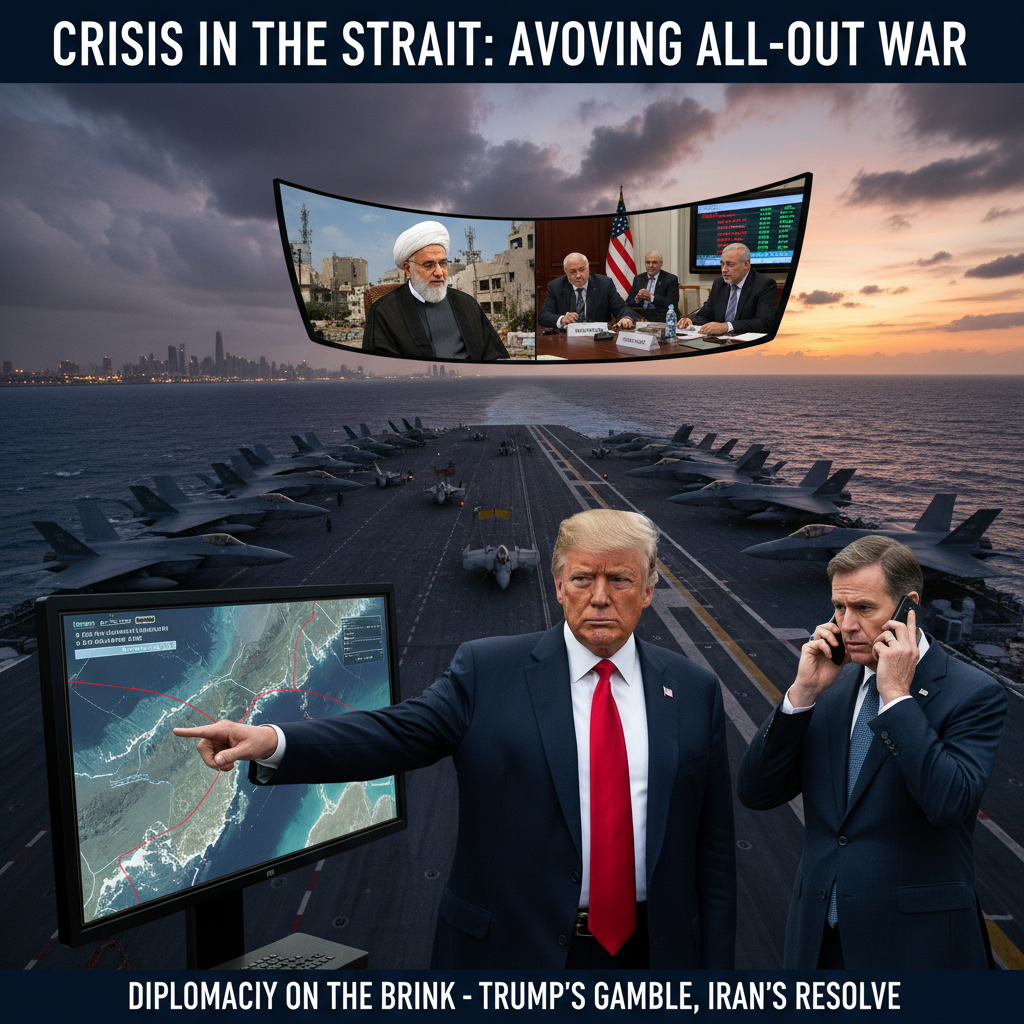
Amid escalating US-Iran tensions following failed Islamabad talks and a new naval blockade, this article outlines a desperate diplomatic push and a comprehensive framework to avert full-scale war, addressing nuclear, sanctions, and security issues.
The recent Islamabad talks between the US and Iran, aimed at ending the ongoing US-Israel war on Iran, collapsed predictably due to vast differences in their proposals. US Vice-President JD Vance's brief visit contrasted sharply with the years-long negotiations that produced the 2015 JCPOA. Vance attributed the failure to Iran's rejection of US terms, despite the US not being in a position to dictate given Iran's firm stance post-ceasefire. Following this, President Trump escalated tensions by imposing a naval blockade on all ships in the Strait of Hormuz, an act of war. This move risks Iran retaliating by attacking Gulf monarchies' energy infrastructure, potentially skyrocketing commodity prices and reigniting full-scale conflict. While the situation is dire, neither side has ruled out further negotiations, with Pakistan and Egypt actively mediating. Both Washington and Tehran have strong incentives to avoid renewed war: Trump faces falling poll numbers, rising inflation, and looming midterm elections, while Iran, having suffered massive damage, would face even greater reconstruction challenges and economic hardship. The article proposes a feasible diplomatic framework: 1) The US recognizes Iran's right to non-military uranium enrichment up to 3.67% with IAEA safeguards, accepting supervised down-blending of its 60% enriched uranium, under a 20-year renewable agreement. 2) Iran pledges not to develop nuclear weapons, reaffirmed by its leadership, in exchange for a parallel Israeli pledge (guaranteed by the US and UNSC) not to initiate a nuclear attack. 3) Iran drops war reparations demands, and in return, the US lifts all sanctions and releases frozen assets. Iran also gains the right to levy a $2 million transit fee per oil tanker through the Strait of Hormuz, overseen by a regional coalition, with the fee ending once reconstruction costs are met and split with Oman. 4) The US and Iran sign a non-aggression pact, ratified by legislatures and embedded in a UN Security Council resolution, with Iran abandoning its demand for full US military withdrawal from the Middle East. For this or any plan to succeed, the US must make compromises, Trump must extend the ceasefire deadline to allow for complex talks, and crucially, Trump must restrain any potential Israeli attacks on Iran.