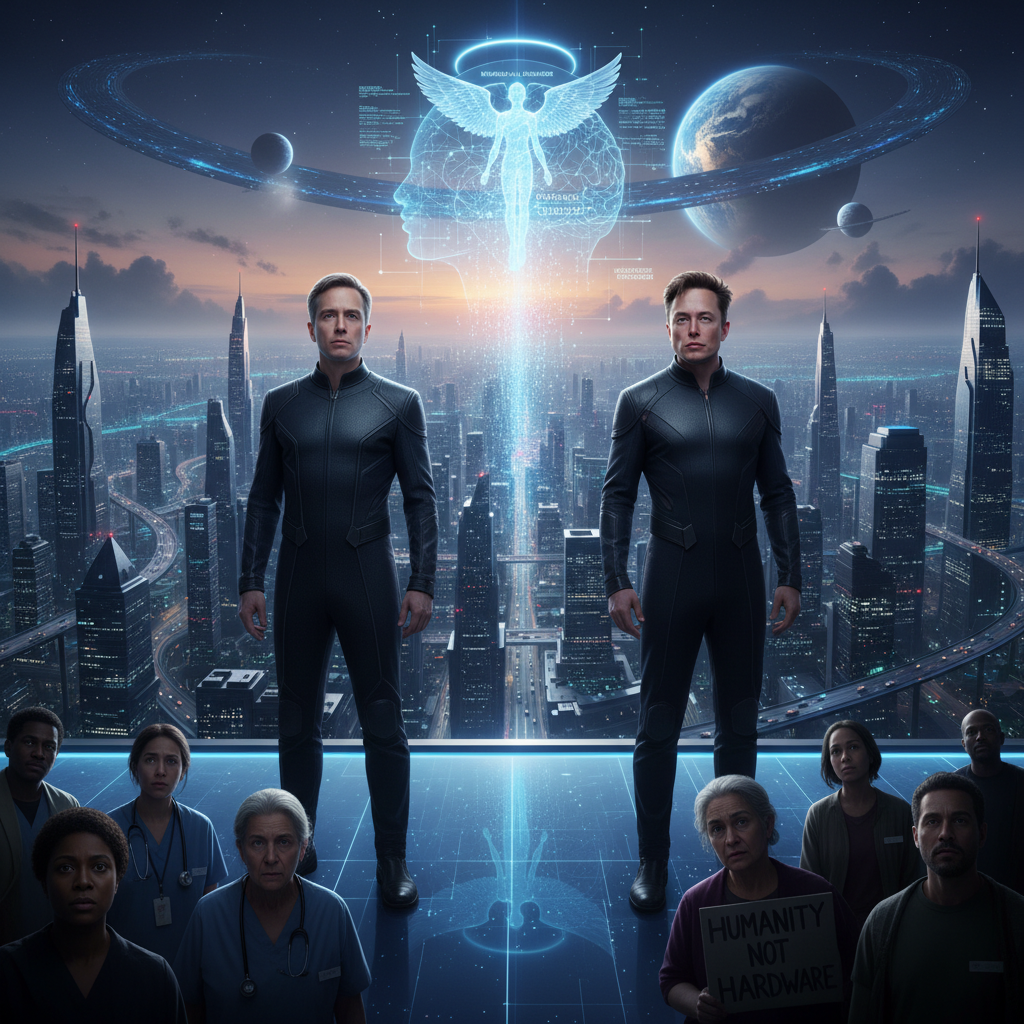
Explore how Silicon Valley's most powerful figures, like Sam Altman and Elon Musk, are embracing a 'transhuman' future, seeing humanity as a 'biological bootloader' for digital superintelligence. This article argues these aren't just sci-fi fantasies but a burgeoning 'techno-mystical' religion, justifying vast resource allocation away from human needs towards a utopian vision of immortality and galactic conquest for a select few, with potentially dire consequences for the rest of us.
The article delves into the transhumanist visions of Silicon Valley's elite, particularly Sam Altman and Elon Musk, who foresee humanity merging with AI or becoming a 'biological bootloader' for digital superintelligence. These aren't mere techie fantasies, but a coalescing belief system among powerful figures, exhibiting hallmarks of a 'religion in the making.' Their dreams, though not perfectly aligned, share a common goal: to achieve immortality and assert cosmic power by distilling human consciousness into digital information, to be downloaded onto non-biological substrates or beamed through space. This 'mythopoeic infrastructure' poses risks, as it justifies steering technology away from the needs and aspirations of everyday humans, focusing instead on a future that only appears utopian to these 'masters of the universe.' The article highlights how resources are being funneled into building superhumans rather than economically useful tools or addressing societal issues like healthcare or poverty. The author attributes this phenomenon to Silicon Valley's 'militantly secular space,' which created a 'God-shaped hole' filled by sci-fi transhuman dreams, offering transcendent meaning to an IT elite indifferent or hostile to traditional religion and moral constraints. Historical parallels are drawn to Henry Ford's utopian projects like Fordlândia, suggesting a pattern of business titans using vast wealth to endow their endeavors with transcendent value. Underlying these ambitions are ideologies like effective altruism, which evolved into 'longtermism' and 'effective accelerationism.' These philosophies justify prioritizing the wellbeing of future 'transhumans' and maximizing intelligent life to consume universal resources, often advocating for rampant techno-capitalism unhindered by regulation. This moral calculus devalues the present needs of earthlings in favor of a vastly more numerous, technologically advanced future. The article expresses concern over the 'flat-out indifference' of these moguls towards the rest of humanity, citing their disregard for AI's energy consumption, potential job displacement, or even existential risks. Despite admitting a lack of understanding of their own AI creations, these unconstrained billionaires are pouring vast sums into political campaigns to fend off regulation and ensure their vision of societal reshaping proceeds unimpeded. However, the article also notes emerging signs of discomfort among the public, religious leaders (like Pope Leo's encyclical 'Magnifica Humanitas' pushing back against AI at the expense of jobs and social equity), and even some within the tech community. It suggests that, like Fordlândia, these far-fetched dreams may ultimately fade into irrelevance, advocating for a more human-centric future with AI as a tool rather than a replacement. The concluding thought is a hope that in their pursuit of a 'transhuman' future, these visionaries do not destroy the world we know.