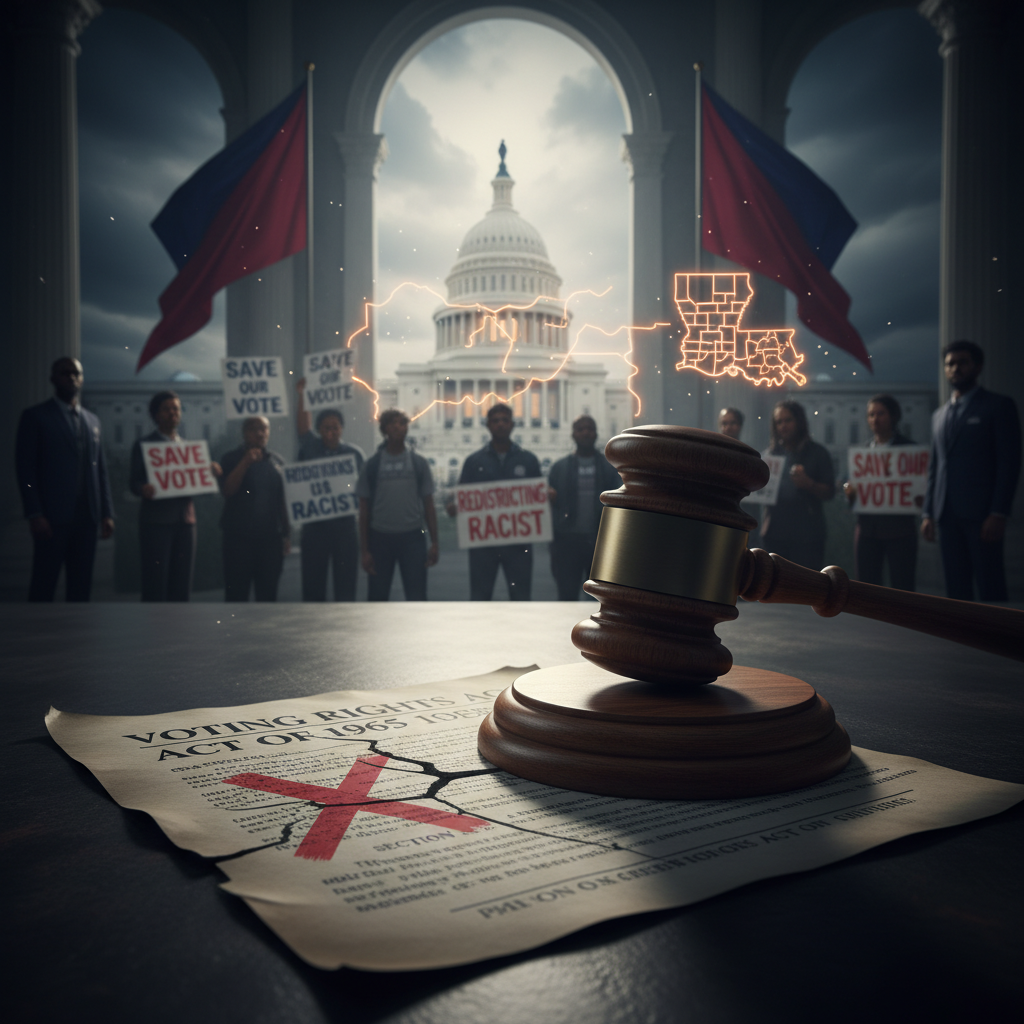
The Supreme Court significantly weakened Section 2 of the Civil Rights-era Voting Rights Act, striking down a majority-Black congressional district in Louisiana. This decision makes it harder for minority communities to challenge redistricting maps that dilute their voting power, potentially aiding Republican efforts to control the House of Representatives, with broader impacts expected by 2028.
The Supreme Court delivered a landmark ruling that significantly weakened Section 2 of the Civil Rights-era Voting Rights Act of 1965, a crucial tool for challenging racially discriminatory election practices. The decision specifically struck down a majority-Black congressional district in Louisiana, opening the door for widespread redistricting across the country that could bolster Republican efforts to secure control of the House of Representatives. While the full impact may be felt more strongly in 2028 due to current election filing deadlines, Louisiana may need to adjust its redistricting plan immediately. The ruling has sparked considerable debate regarding the remaining efficacy of Section 2. Justice Elena Kagan, in a dissent joined by the two other liberal justices, warned that the court's "gutting of Section 2 puts that achievement in peril," echoing sentiments from former President Barack Obama who criticized the court for abandoning its role in ensuring equal democratic participation. Opponents argue the decision will make it substantially harder for minority communities to contest redistricting maps that diminish their political influence. Conversely, Justice Alito, writing for the majority, asserted that "allowing race to play any part in government decisionmaking represents a departure from the constitutional rule," effectively limiting Section 2's application to instances of intentional discrimination, a very high legal standard. White House spokeswoman Abigail Jackson lauded the decision as a "complete and total victory for American voters," stating that "the color of one’s skin should not dictate which congressional district you belong in." The reaction to the decision largely followed partisan lines. Democrats, including Rep. Suzan DelBene, condemned it as an "appalling" and "corrupt and targeted assault on the voting rights of Black and Brown Americans." Former President Donald Trump, who had advocated for redistricting to boost Republican chances, praised the ruling, calling it "the kind of ruling I like." The immediate political fallout was evident in Florida, where the state legislature, despite Democratic pleas for delay, swiftly approved a new congressional map proposed by Republican Gov. Ron DeSantis, aiming to gain up to four House seats for the GOP. This ruling marks a significant reversal from a similar case involving Alabama less than three years prior, which had led to the creation of new majority-Black districts. Chief Justice John Roberts, who joined the majority in Wednesday's decision, has a long-standing history of seeking to limit the scope of the Voting Rights Act, having previously authored the 2013 decision that eliminated the VRA's preclearance requirement for states with histories of discrimination. Experts, such as political scientist Jonathan Cervas, now suggest that "The Voting Rights Act as a means to protect minority voters from vote dilution is essentially dead," with the broader impact potentially leading to the replacement of over a dozen Democratic-held House districts previously protected by the VRA by 2028.