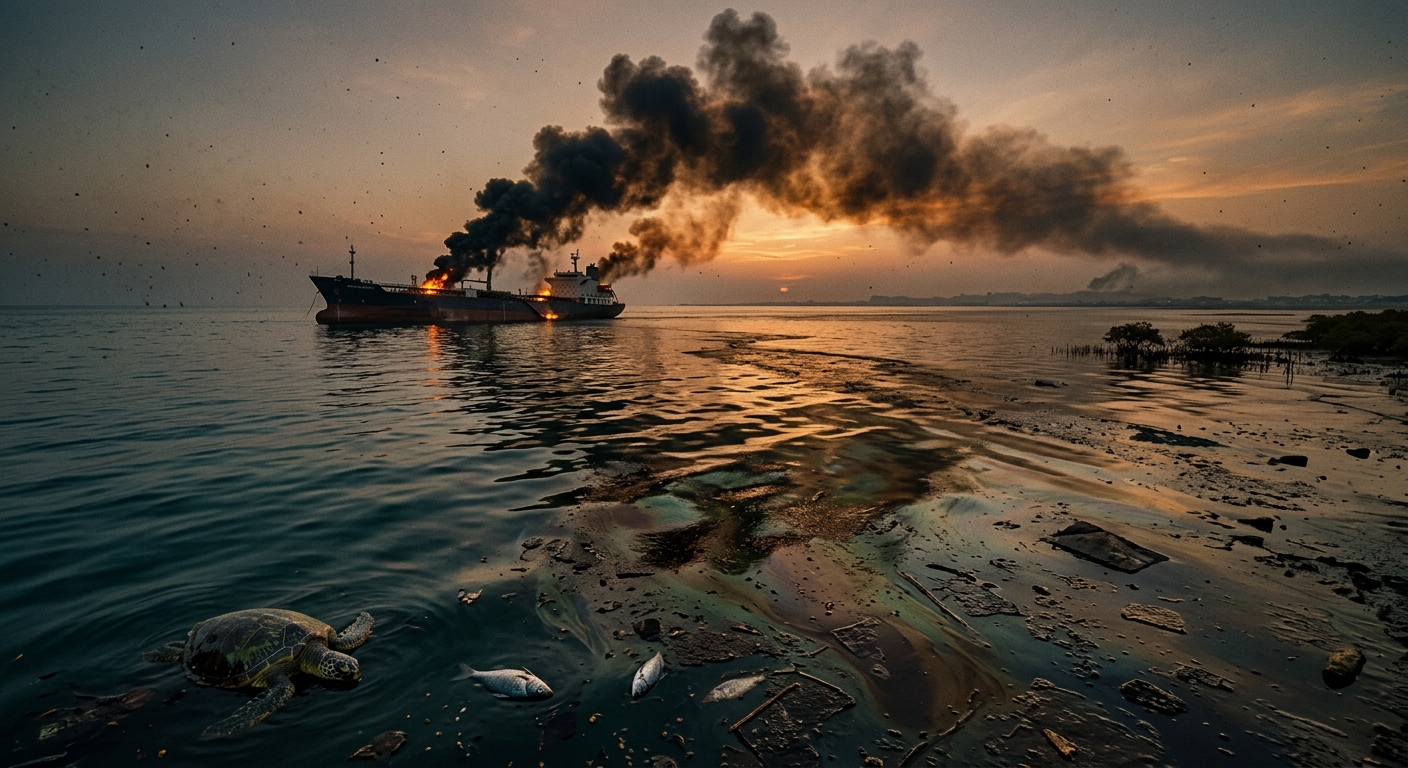
The ongoing conflict in the Middle East, involving US-Israeli and Iranian strikes, is causing severe environmental damage to the Persian Gulf. Bombs, missiles, and attacks on oil facilities and ships are leading to massive oil spills, chemical pollution, and threatening unique marine ecosystems, critical desalination plants, and vital climate change research.
The ongoing conflict in the Middle East, characterized by US-Israeli and Iranian strikes, is creating a significant environmental catastrophe in the Persian Gulf, one of the planet's most unique and delicate marine ecosystems. Attacks involving bombs and missiles release heavy metals and harmful chemicals, while strikes on oil facilities ignite fires, covering areas like Tehran in thick smoke and oil-saturated rain, exposing millions to health risks. Crucially, the Persian Gulf itself is experiencing a surge in oil pollution, with satellite imagery revealing twice the expected surface oil compared to previous years, creating plumes stretching for hundreds of kilometers. This pollution, often from targeted cargo ships and oil tankers in the Strait of Hormuz, directly threatens the Gulf's teeming biodiversity, including sea turtles, hundreds of fish species, the world’s second-largest dugong population, whale shark congregations, and vital coral reefs and mangrove forests, especially during crucial breeding seasons. The Gulf's unique characteristics—its shallowness, small size, and single entry/exit point—mean pollutants do not disperse or dilute easily, leading to widespread, long-lasting contamination, a lesson from the 1991 Gulf War. Furthermore, the pollution jeopardizes the drinking water supply for tens of millions of residents who rely on desalination plants, as seen during the Iraq war when Kuwait faced a severe water crisis. Beyond immediate ecological and humanitarian concerns, the environmental degradation in the Persian Gulf undermines critical climate change research. The Gulf's extreme temperatures and hardy marine life make it a 'natural laboratory' for understanding how oceans will adapt to future climate conditions, holding 'some of the most valuable genetics' on Earth. Experts warn that the loss of these ecosystems and species, once degraded, may not recover, highlighting a looming catastrophe with far-reaching consequences.