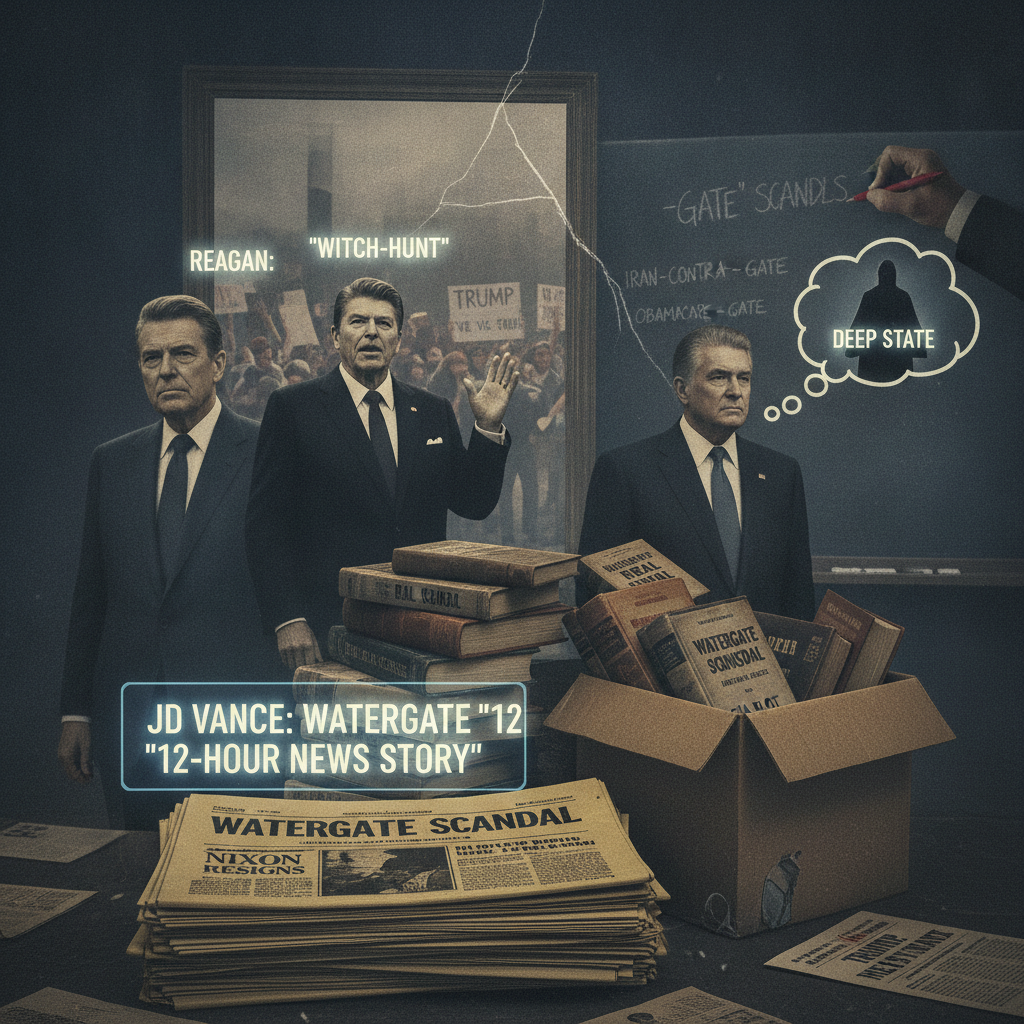
JD Vance's recent minimization of Watergate as a '12-hour news story' is not a new phenomenon, but rather a continuation of a long-standing Republican strategy to downplay the scandal, tracing back to figures like Ronald Reagan, who used rhetorical absolution to gain political traction.
The article critiques JD Vance's recent assertion that Watergate was a 'crazy' event taken down by the 'deep state' and would be a mere '12-hour news story' today. The author highlights the historical facts of Nixon's involvement in a conspiracy to obstruct justice, including attempts to bribe burglars and launder money. While commentators expressed shock at Vance's remarks, the author argues that this minimization is not a new low, but a consistent pattern in Republican politics. The article traces this back to Ronald Reagan, who, despite Nixon's clear culpability, dismissed the Watergate investigation as a 'witch-hunt' and called Nixon's denials 'the voice of reason.' Reagan's ability to rhetorically absolve fellow Republicans of wrongdoing, the author contends, made him highly attractive to conservatives and contributed to his eventual presidency. Other figures, like Pat Buchanan, also minimized Watergate by framing it as a liberal establishment plot. The article further details a 'steady stream of books' promoting conspiracy theories about Watergate, blaming the CIA, John Dean, or others, and the widespread adoption of the phrase 'everyone did it, Nixon got caught.' William Safire's technique of affixing '-gate' to other scandals also served to dilute Watergate's unique severity. The author concludes that this 'unbroken lineage of Watergate propaganda' is precisely why Vance's prediction of it being a '12-hour news story' could be correct, as it reflects a deep-seated conservative strategy of 'we' cracking down on 'them,' a spirit evident in Donald Trump's rhetoric today.