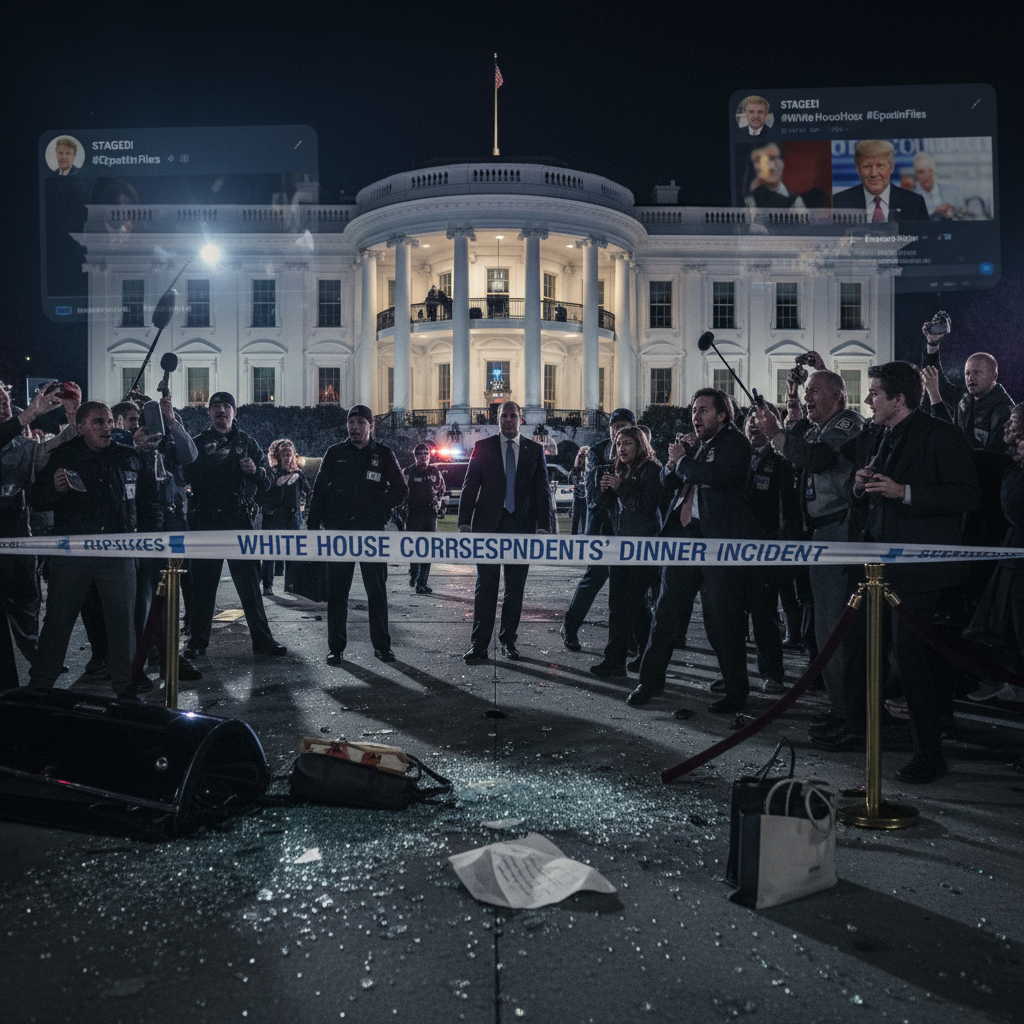
A shooting at the White House Correspondents' Dinner, initially an assassination attempt, was quickly met with widespread public skepticism and conspiracy theories, highlighting America's growing distrust in official narratives and the alarming normalization of political violence.
The article details a shooting incident at the White House Correspondents' Dinner, which the author learned about in the early hours of Sunday. Despite the attack being thwarted with no fatalities, the event immediately triggered a wave of public skepticism and conspiracy theories across social media. Many suggested the incident was 'staged' to distract from other national issues like the war in Iran, the struggling economy, or the Epstein files, drawing comparisons to a previous 'uncredible' 2024 shooting involving Donald Trump. Public suspicion also arose from the president's seemingly unruffled reaction, as he quickly pivoted to advocating for a new high-security White House ballroom. The shooter was later identified as a 31-year-old Californian engineer who had allegedly sent his family a 'manifesto' expressing anger at the administration. However, his capture did little to alleviate public fears, which the author attributes to a deep-seated erosion of trust in government and media. The article argues that a history of political leaders and cultural figures being caught in lies, misrepresentations, and cover-ups has conditioned Americans to doubt official narratives. Examples cited include incomplete stories about the war in Iran, unindicted figures in the Epstein scandal, and officials refusing to answer direct questions in congressional hearings. This constant exposure to falsehoods, the author contends, justifies public skepticism regarding the White House dinner incident. Beyond distrust, the article emphasizes the horrifying normalization of violence, particularly political violence. Massacres and school shootings now rarely make headlines unless the body count is exceptionally high. The author contrasts this desensitization with the profound shock and trauma felt nationwide during historical events like the assassinations of JFK, RFK, MLK, and the attempted assassination of Ronald Reagan. Today, murders occur so rapidly across the political spectrum (e.g., Charlie Kirk, Renee Good, Alex Pretti, and thousands in Gaza/Lebanon/Iran) that the nation is overwhelmed, numb, and unable to process the grief. The article concludes that this rapid succession of brutal deaths, coupled with the erosion of trust, leads to alternating periods of outrage and exhaustion, where even those with a conscience can hear of a new calamity and, like the author, simply go back to sleep.