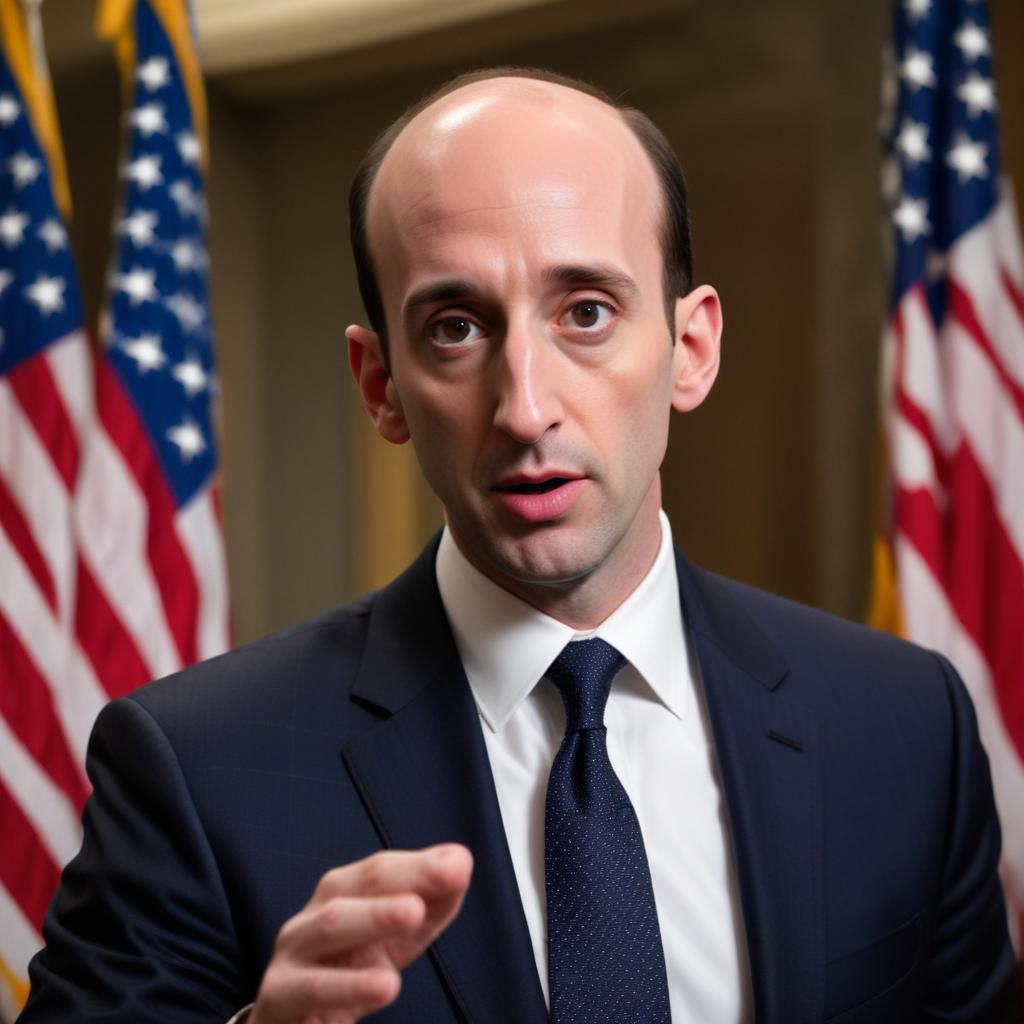
Stephen Miller, Trump's deputy chief of staff, is revealed as the true architect of the administration's most extreme policies, from immigration crackdowns to foreign affairs. The article explores his zealous past and anti-immigrant stance, culminating in a critical yet humorous take on his personal quirks, suggesting that laughter is a powerful weapon against authoritarians like him.
This article posits that understanding the current and future direction of the US requires focusing on Stephen Miller, Donald Trump's deputy chief of staff, rather than Trump himself. Miller, who has declared 'America is for Americans and Americans only' and aims to 'save the west,' is portrayed as the primary force driving the Trump administration's most extreme domestic and foreign policies, with some aides even privately calling him 'the prime minister.' His influence is linked to aggressive immigration tactics, efforts to eliminate birthright citizenship, the plot to capture Venezuelan President Nicolás Maduro, and the 'Maga-fication' of universities. The author details Miller's long history of zealotry, tracing his anti-immigrant sentiments back to high school, where he reportedly refused friendship due to a classmate's Latino heritage and complained about Spanish-speaking students. As an aide to Senator Jeff Sessions, he gained prominence by fighting a bipartisan immigration reform bill, and during Trump 1.0, he was the mastermind behind the separation of immigrant families at the US-Mexico border—a policy publicly condemned by his own uncle. He later married Katie Waldman, an immigration spokesperson who shared his views. The article then shifts to a more personal, albeit mocking, anecdote: Miller's alleged extreme fondness for mayonnaise, which his wife mentioned on her podcast. The author uses this detail, along with others like Ivanka Trump's 'super-white dog,' to evoke a sense of 'lazy AI' scripting for 'America: The Final Season.' While acknowledging the seriousness of Miller's power and vision, the author uses the mayonnaise anecdote not to humanize him sympathetically, but to diminish him, portraying him as a 'pathetic little man.' The piece concludes by urging readers not to succumb to fear of authoritarians but to actively laugh at them, emphasizing that 'there is nothing thin-skinned authoritarians hate more than being laughed at.'