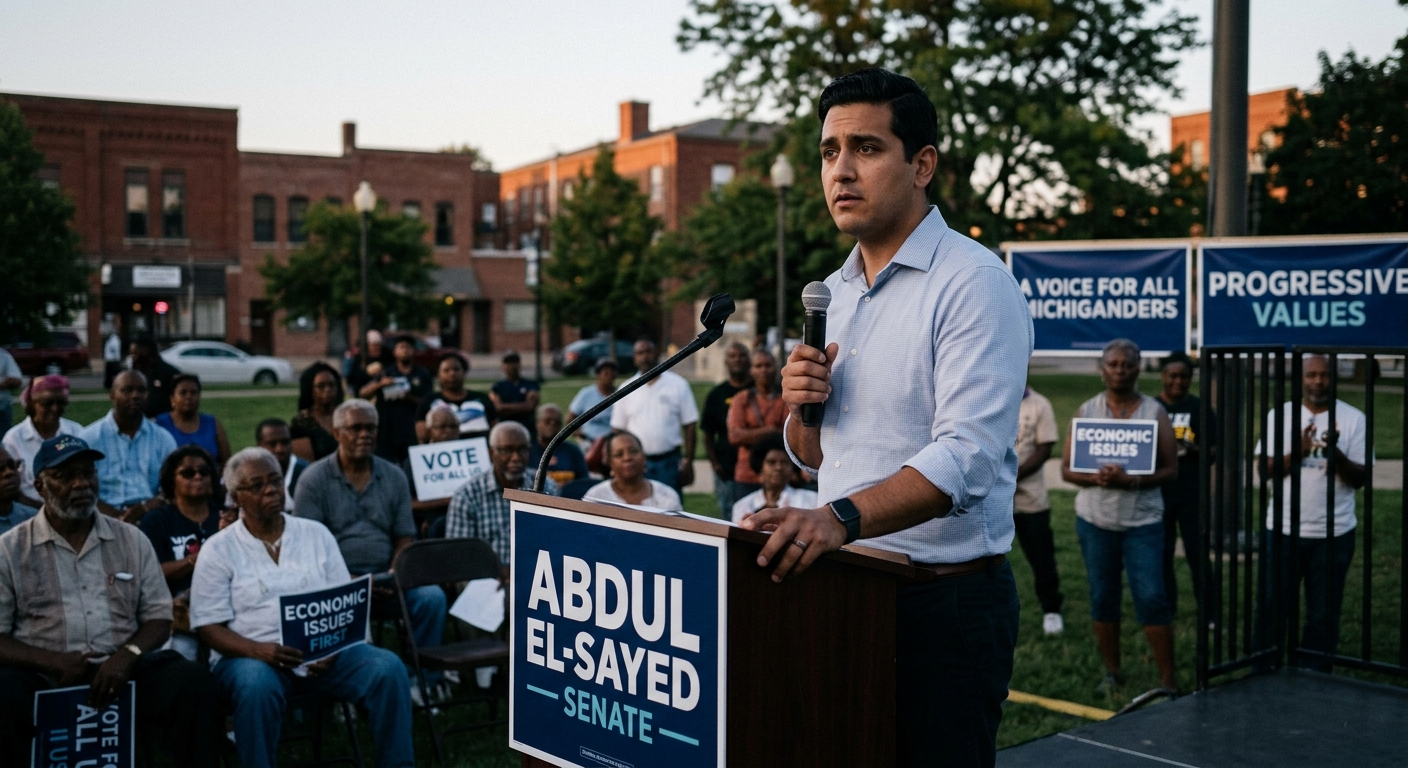
Despite an impressive resume and progressive platform, Michigan Democratic senatorial candidate Abdul El-Sayed is facing a significant challenge in gaining support from Black voters. His strategy of 'political universalism,' which avoids explicit appeals to specific demographic groups in favor of common issues, appears to be leading to 'unfamiliarity' and a lack of enthusiasm within the Black community, potentially jeopardizing his campaign.
Abdul El-Sayed, a 41-year-old Rhodes scholar and progressive Michigan Democratic senatorial candidate, is struggling to secure the Black vote, despite being competitive in overall polls. A Washington Post-Schar School poll revealed that while 83% of likely Black voters desired Democratic control of the Senate, only 67% backed El-Sayed. His campaign attributes some of this gap to negative primary ads, but a key factor is his 'political universalism' strategy, which prioritizes common issues over specific, differentiated interests of various demographic groups. El-Sayed believes this approach unites voters across their similarities, rather than pandering to differences. Consequently, his campaign website and speeches largely avoid explicit mentions of minority groups, race, or racism. For example, his 'Priorities' section omits these terms, and discussions on immigration or civil rights are framed broadly without naming specific communities like Hispanics or Black people, even when discussing issues like the Flint water crisis or HBCUs. This lack of direct acknowledgment appears to contribute to a lack of enthusiasm and 'unfamiliarity' among Black voters, particularly older ones accustomed to direct appeals. A rally in Flint, a predominantly Black city, saw low Black attendance, and El-Sayed's response to a question about engaging the Black demographic remained generalized. While his campaign has engaged with Black churches and leaders, a post-primary press release addressing Black community priorities was buried on his site. To boost his standing, high-profile Democrats like Kamala Harris and Barack Obama are campaigning for El-Sayed. However, El-Sayed has a public history of criticizing both, raising questions about the transferability of their goodwill, especially among Black voters who hold Obama in high esteem. Adding to his challenges is potential Islamophobia; as a Muslim candidate, polls suggest a significant portion of Michigan voters would not consider voting for a Muslim for president, a factor El-Sayed addresses by downplaying his identity's relevance to common political concerns. El-Sayed also underperformed in primary polls, narrowly winning despite pre-election surveys showing a commanding lead, which some suggest could hint at a 'Bradley effect.' Despite these hurdles, El-Sayed is gambling on a broader 'blue wave' and a focus on economic issues to carry him to victory, betting on Michiganders' willingness to support a politics 'good for all of us' without making more direct appeals to specific constituent groups.