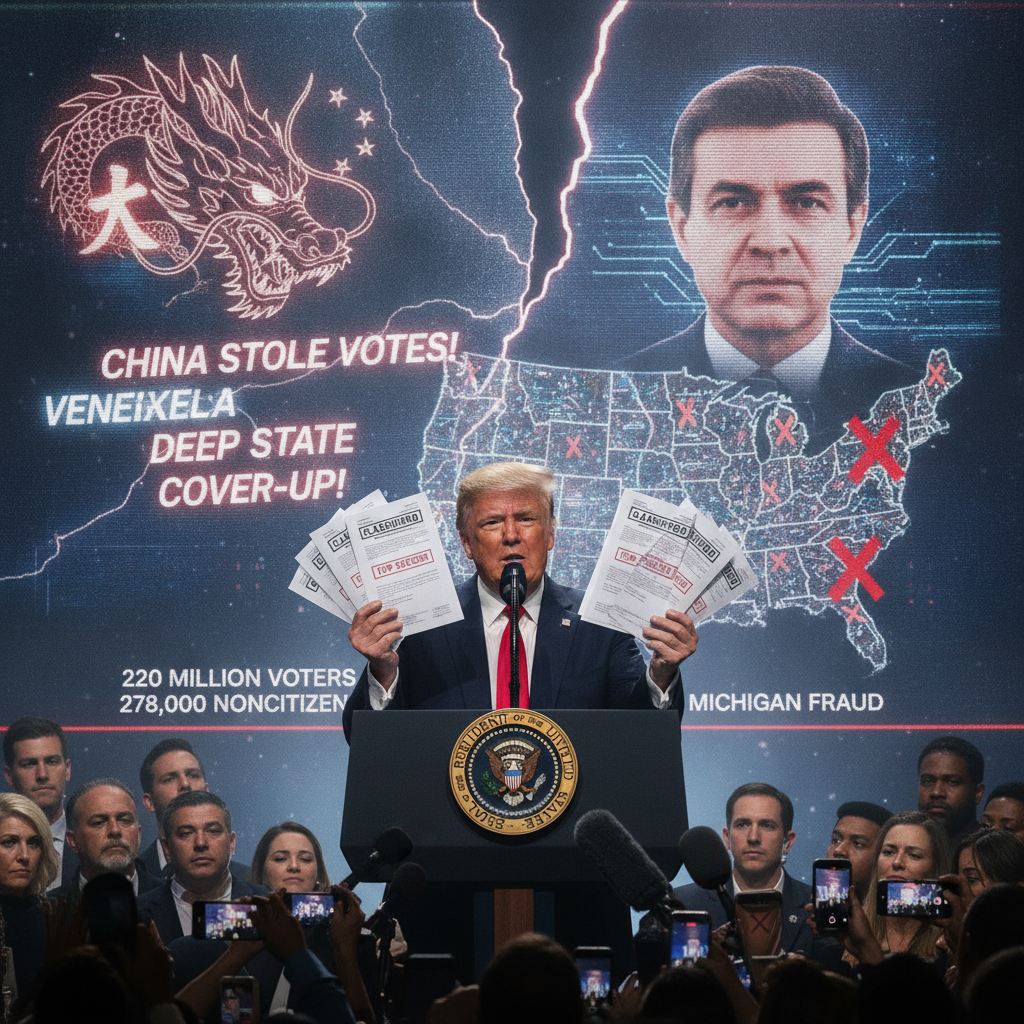
Donald Trump presented a series of misleading and false claims regarding threats to US elections, including alleged Chinese hacking of voter files, intelligence cover-ups, Venezuelan manipulation of voting machines, uninvestigated Michigan voter fraud, and noncitizen voter registrations. Despite releasing classified documents to support his assertions, these documents often lacked clear evidence or were misinterpreted, with experts and officials refuting his claims.
During a speech on US election threats, Donald Trump presented a series of misleading and false claims, attempting to substantiate them with previously classified documents. However, these documents frequently failed to support his assertions, and in many instances, his claims were directly contradicted by facts or expert analysis. Firstly, Trump alleged that China illicitly acquired voter information for 220 million US voters since 2020 for "nefarious activities." While documents showed someone acting on behalf of China downloaded commercially available voter registration information from at least six states in 2022, nearly all US states allow public access to such data. Experts emphasized that possessing publicly available data does not enable changing votes or voter registrations, calling Trump's assertion "100% false." Secondly, Trump claimed US intelligence officials conspired to withhold information about Chinese election meddling from him. A 2021 National Intelligence Council report, however, concluded with high confidence that China did not interfere in the 2020 election. Although a dissenting view acknowledged China took "some steps" to undermine Trump via social media, it explicitly stated no information suggested interference with election processes. Documents released by Trump revealed internal debates and concerns about politics influencing reporting but lacked definitive evidence of a cover-up, with snippets like "massaging" intelligence briefings lacking crucial context. Thirdly, Trump insinuated Venezuela hacked US voting machines, referencing a debunked conspiracy theory. A CIA note indicated Venezuela developed "some capability" to manipulate electronic voting systems, including Smartmatic technology (used in Los Angeles County), in Venezuela. Crucially, the note did not confirm large-scale electronic fraud was successfully executed in specific Venezuelan elections, and a Trump ally admitted there was no evidence of Venezuelan tampering in US elections. Fourthly, Trump asserted the Biden administration "slow-walked" and "killed" an investigation into voter fraud in Michigan in 2020. Public reporting shows a local clerk flagged problematic voter registration applications from a third-party group, and the FBI investigated the case throughout the Biden administration, consulting with the Justice Department. A document indicated that "no further investigation is warranted" because leads were exhausted, and no criminal violation was identified, suggesting a thorough investigation rather than a cover-up. Finally, Trump claimed the Department of Homeland Security identified 278,000 noncitizens registered to vote in California, Nevada, New Jersey, and Pennsylvania. The DHS did not disclose its methodology, and its tool for flagging noncitizens is known to be inaccurate. Letters from DHS to Nevada and Pennsylvania revealed much less certainty, with Nevada's letter identifying "as many as" 15,903 potential noncitizens, but only 8,576 having matching data in noncitizen files. Nevada's Secretary of State dismissed these numbers as "wildly speculative," reinforcing broader studies that show voter fraud, especially by noncitizens, is extremely rare.