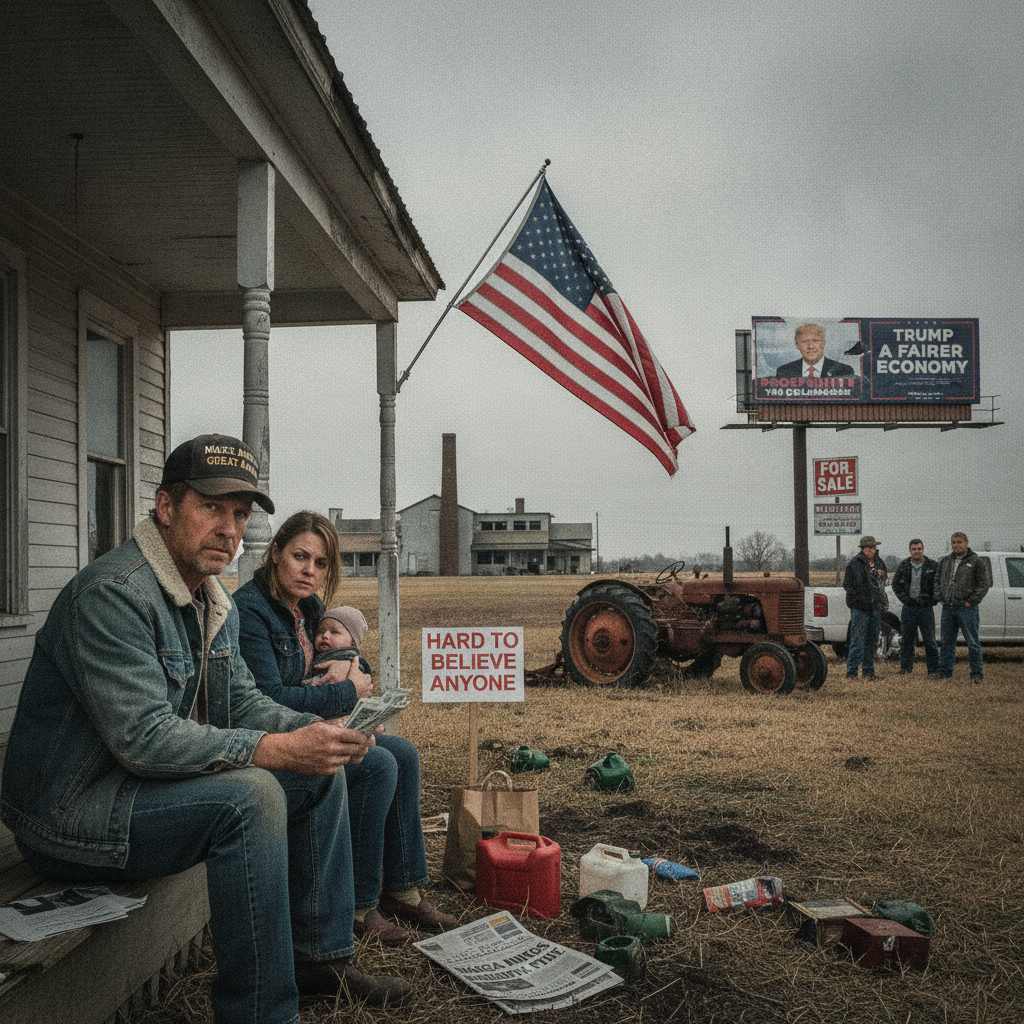
Donald Trump's policies are increasingly alienating his core 'Maga' base, with recent polls showing significant economic hardship among his most loyal supporters. Voters, including rural Americans and those without college degrees, are blaming the government for rising costs and worsening financial security, driven by issues like tariffs and subsidy cuts. While not abandoning Trump entirely, their patience is wearing thin, signaling potential electoral trouble for Republicans, even as Democrats struggle to present a compelling alternative.
The political repercussions of Donald Trump's policy decisions are becoming clear, as his 'Maga' base expresses growing frustration. Policies initiated by Trump are reportedly sabotaging various core constituencies, including farmers, rural Americans, and manufacturing workers, leading to widespread economic hardship. A recent Harris survey for the Guardian reveals that even self-identified Maga supporters are becoming impatient, increasingly attributing their economic woes to the government. A significant majority of Maga respondents reported difficulties or worries about meeting debt, housing, healthcare, utility, grocery, and gas payments. These stressors are linked to Trump's policy preferences, such as ending government subsidies (contributing to rising health insurance costs), the impact of Iran's actions on energy costs and inflation, and tariffs that have led to manufacturing job losses and higher costs for farmers. Key Maga demographics, including rural Americans (who voted heavily for Trump in 2024) and those without a four-year college degree, report a worsening personal financial situation. Crucially, 54% of Maga faithful believe the government is most responsible for rising prices, and 41% accept that American consumers, not foreigners, bear the costs of Trump's tariffs, contrary to White House claims. While Maga voters have not entirely abandoned the president—with a growing percentage of Republicans identifying as Maga—misgivings are evident, as over a third believe the government has worsened their situation. Beyond his base, discontent is brewing among other Republicans and independent voters, whose financial security is also deteriorating. This widespread voter dissatisfaction, just months before the midterm elections, could presage a significant shift in Congress. However, Americans are not convinced that Democrats offer a better solution, with only slightly more believing Democrats can fix the affordability crisis than Republicans, and a large portion trusting neither party. This leaves American politics in an ambiguous state, with voters losing patience with Trump but wary of Democrats, presenting an opportunity for Democrats to formulate a strong economic counter-strategy.