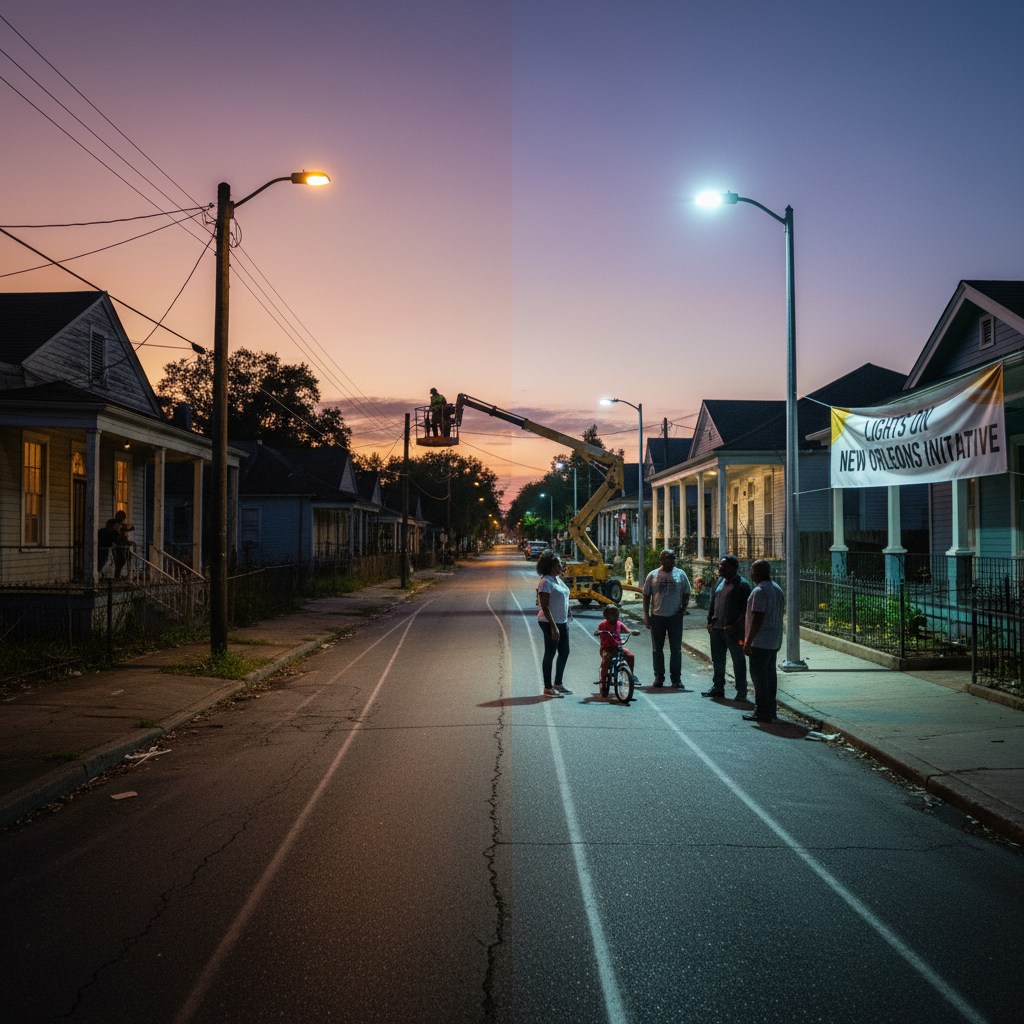
Public lighting in American cities is more than just about visibility; it's a profound indicator of socioeconomic and racial inequality, often signaling systemic disinvestment in underserved neighborhoods. New Orleans' "Lights On" initiative, a $2.8 million project, aims to address this by repairing and upgrading streetlights in areas like New Orleans East, not only to improve safety and reduce crime but also to foster community revitalization and social reform.
The article delves into the dual meaning of public lighting—security or surveillance—and its deep connection to race and class in American cities, echoing Ralph Waldo Emerson's 19th-century observation. It highlights how well-lit streets often signify affluent areas, while inadequate lighting in lower-income, often majority-Black neighborhoods, such as New Orleans East after Hurricane Katrina, reflects systemic disinvestment. Legal scholar Angela Allen-Bell notes that lighting schemes can "reflect, illuminate and reproduce inequalities." To combat this, New Orleans launched the "Lights On" initiative, a $2.8 million project led by Mayor Helena Moreno, to repair and replace broken streetlights in underserved areas with energy-efficient LED technology. The program, which has already replaced or repaired over 1,600 lights, aims to enhance public safety, reduce crime, fix neglected infrastructure, restore public trust, and create a coordinated citywide lighting system. While some residents, like Dawn Herbert, report feeling safer, others, like Claudia Celestine, see little change. Experts like Dr. Maria Barrera-Vilert emphasize that effective lighting should be part of a broader strategy to reduce crime without intrusive surveillance, by enhancing community interaction. Ultimately, the initiative seeks not only to illuminate the streets of New Orleans East but also to encourage proper neighborhood revitalization and social reform, addressing historical disparities.