Recent Democratic primaries reveal an intense ideological struggle, with progressives scoring key victories like Abdul El-Sayed's, demonstrating a growing left-wing force capable of winning beyond traditional strongholds. While the Democratic electorate is shifting, building a mass left is a slow process, and the movement's next major challenge is proving it can win general elections against Republicans in swing states, a critical test for its long-term viability and presidential aspirations.
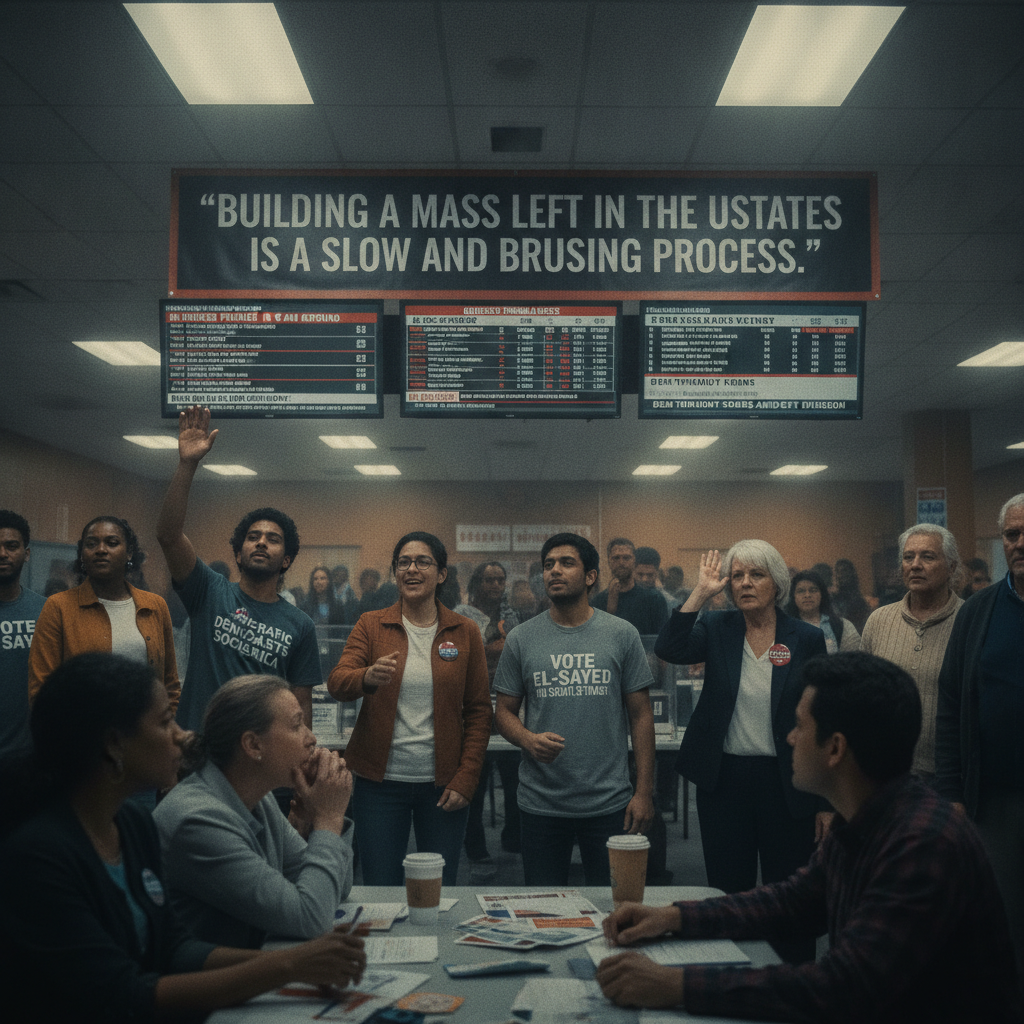
The ideological struggle within the Democratic party continued on Tuesday night with primaries in Kansas, Michigan, Missouri, Virginia and Washington. The results showed an increasingly intense conflict within the party, with high Democratic primary turnout and bruising ideological battles up and down the ballot. The Democratic electorate is shifting, becoming more progressive and more willing to challenge party leadership, but not as quickly or uniformly as many assumed. Progressives and socialists scored another round of victories, most notably Abdul El-Sayed for Senate, but also downballot with Donavan McKinney and Will Lawrence in congressional races, and in state legislative seats such as Chris Gilmer-Hill in Detroit. But the scale and breadth of those victories fell short of the expectations created by polling and media coverage. Abdul El-Sayed offers a template for Democrats to defeat Trumpism | Peter Beinart Read more A few key lessons have emerged. First, building a mass left in the United States is a slow and bruising process, and there is no single tipping point at which the party and its voters suddenly become committed leftwing partisans. Second, the left is nonetheless growing rapidly, able to win beyond young, deep-blue urban areas where concerns about general-election viability against Republicans are relatively limited, and across an entire statewide Democratic primary electorate in a swing state. This is a major step in the left’s development as an electoral force. Third, the left’s next and most important challenge is winning swing states and competitive seats against Republicans. The left has enjoyed a string of notable electoral victories during the second Trump administration, beginning with Zohran Mamdani’s primary win in New York City, and continuing up through the 2026 primaries. The Democratic electorate’s attitudes are changing: party leadership has grown less popular, while democratic socialism has gained support. The left has quickly gone from an extremely marginal force, with just a handful of members of Congress, largely confined to deep-blue urban districts and a small number of favorable constituencies, to a driving force in the party. Much of the media coverage has portrayed the party as being overtaken by an ascendant left. That broader narrative, reinforced by favorable polling, created an expectation that El-Sayed would win resoundingly. In practice, the recent wave means that a meaningful additional share of Democratic primary voters, perhaps 10-15%, is now willing to consistently support left candidates, on top of the existing leftwing base. double quotation markBuilding a mass left in the United States is a slow and bruising process, and there is no single tipping point at which the party and its voters suddenly become committed leftwing partisans It does not mean that every candidate backed by the DSA or the broader progressive movement will automatically win, or every Democrat backed by Aipac will lose. The actual campaign still matters tremendously; a large share of Democratic voters remain moderate, cross-pressured or primarily candidate-driven. Politics just doesn’t move that fast. The project of building a leftwing base and turning it into a durable majority, even within the Democratic party, is still a long-term one. El-Sayed’s narrow victory has been described as disappointing, because of favorable polling and the expectations created by the recent wave of leftwing victories. It is anything but. The polling miss has distorted how the result is being interpreted. Viewed against Michigan’s demographics, the left’s previous statewide performance, spending disparities, endorsements and comparable results elsewhere in the country, the victory was historically significant. The left has not previously won a genuinely competitive statewide Democratic primary of this kind, nor has a left candidate previously assembled a winning primary coalition extending this far beyond the movement’s urban base, especially in a swing state where voters are likely to weigh general-election viability. The left’s strategy over the past decade has been one of patience, winning seats in friendly areas, knocking doors and slowly building a base. It began by winning city council and state legislative victories and expanded more recently into successful mayoral and congressional races, all in deep blue areas. The Democrats have one last chance to halt the erosion of US democracy – and it’s less than 100 days away | Timothy Garton Ash Read more This is the first time the left has real proof of concept that beyond urban cores with friendly demographics, it can win over a majority of Democratic voters. It also offers early evidence that a left candidate could compete seriously in a Democratic presidential primary in 2028. The next test is November. The left has been battle-tested in primaries against moderate candidates, party institutions and well-funded outside groups such as Aipac and the crypto lobby. But a general election in a swing state is a different and less hospitable terrain. El-Sayed, along with Francesca Hong if she advances in Wisconsin, needs to demonstrate the left can win not only a winning Democratic primary coalition, but a broad enough general-election coalition to prevail outside deep-blue territory. This matters in the near term, for Democrats to win the Senate and retain governorships; in the medium term, because presidential primary voters in 2028 will want evidence that left candidates can win competitive general elections; and in the long term, because the leftwing political project rests on being able to twin and govern with durable electoral majorities. On Tuesday, the left continued its string of victories, activating young voters and bringing Arab and Muslim voters back into the Democratic fold. But these victories do not resolve the movement’s central challenges. Every primary remains a brutal fight, highly contingent on candidates, organization, spending and local conditions. And the movement must now prepare for the more difficult terrain of November. The left is increasingly winning within the Democratic party, but it still needs to prove that it can build general-election coalitions capable of defeating Republicans. Ben Davis works in political data in Washington DC. He worked on the data team for the Bernie Sanders 2020 campaign and is an active member of the Democratic Socialists of America