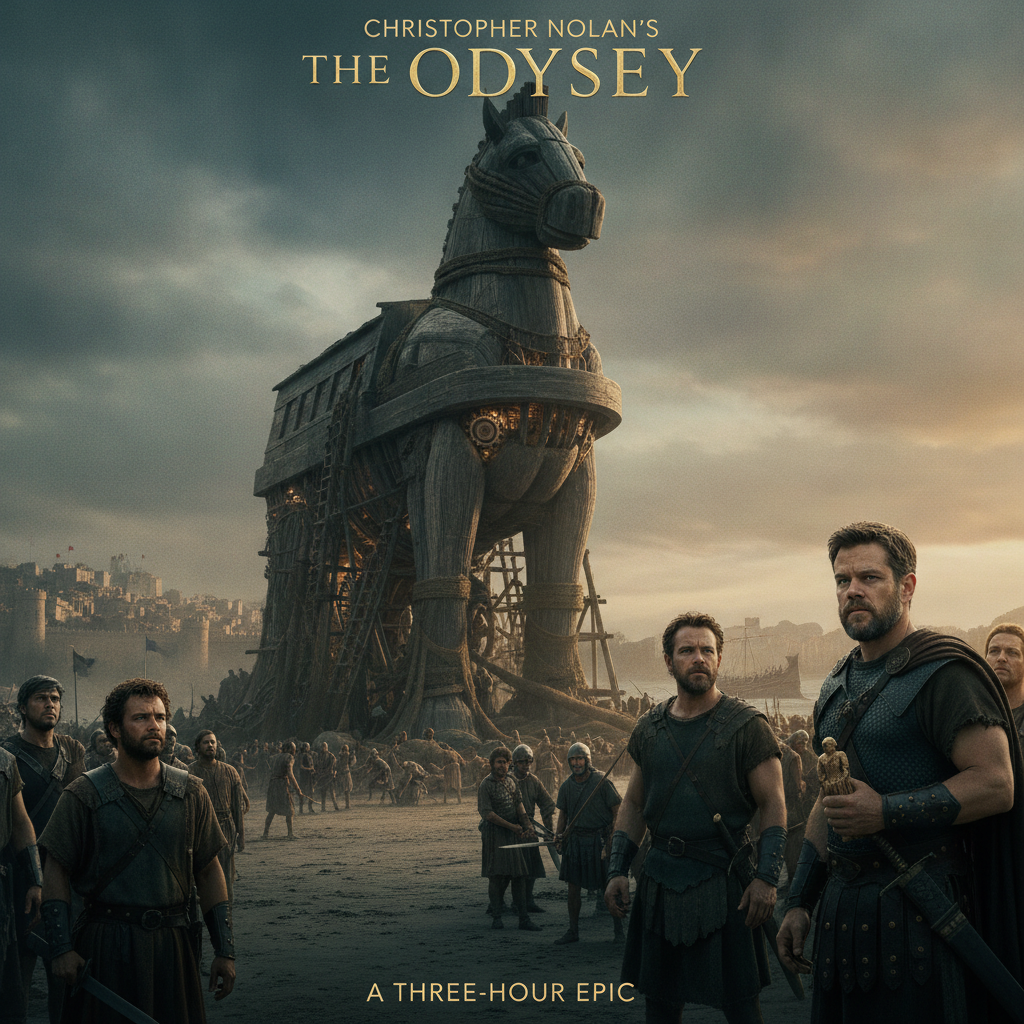
Christopher Nolan's film adaptation of Homer's 'The Odyssey' takes significant liberties with the ancient Greek epic, cutting key characters and scenes, adding new elements, and altering famous episodes to fit a three-hour runtime.
Christopher Nolan's three-hour film adaptation of Homer's 12,000-line poem, 'The Odyssey,' necessitated extensive alterations. Nolan streamlined the narrative by omitting most of the Olympian gods, depicting Athena (Zendaya) solely as a vision representing Odysseus's conscience. He entirely removed the celebrated encounter with Nausicaa and the Phaeacians, instead having Odysseus (Matt Damon) recount his tales of the Cyclops and Circe to Calypso (Charlize Theron) as recovered memories. Major ghosts like Achilles, Ajax, Odysseus's mother, and Elpenor were also cut from the realm of the dead. Nolan notably eschewed the poem's brutal execution of disloyal enslaved women, though he introduced a scene where Penelope (Anne Hathaway) effectively condemns the treacherous Melantho (Mia Goth). The iconic 'bed test,' where Penelope confirms Odysseus's identity by his knowledge of their olive-tree bed, was replaced by Odysseus showing her an Athena figurine. Conversely, Nolan added elements not present in Homer, such as a full depiction of the Trojan Horse story (only mentioned in Homer) and the character Sinon (Elliot Page), borrowed from Virgil's Aeneid, who tricks the Trojans. He also introduced new thematic concerns like 'people from the sea' and the Trojan War being about 'trading routes,' reflecting modern historical interpretations. Significant changes were made to existing characters and plot points. Nolan's Calypso sedates Odysseus with lotus flowers and releases him out of pity, a departure from Homer's Calypso who forces him to stay for years and only releases him under Zeus's command. The film's Cyclops is largely silent, losing Homer's 'Nobody' ruse and Odysseus's reckless self-identification, thereby downplaying his trickster persona. Circe (Samantha Morton) is motivated by anger towards male behavior and meekly restores Odysseus's men, contrasting with Homer's Circe who turns men into pigs, is immune to Odysseus, and becomes a helpful ally and lover for a year. The ambush on Telemachus (Tom Holland) is shifted from sea to a temple, with Odysseus directly intervening, leading to an immediate father-son reunion, unlike Homer's Athena-orchestrated event. Finally, Nolan provides a more conclusive ending, omitting Homer's 'unsatisfactory' final scenes, with Telemachus becoming king and Odysseus and Penelope sailing off to honor fallen comrades.