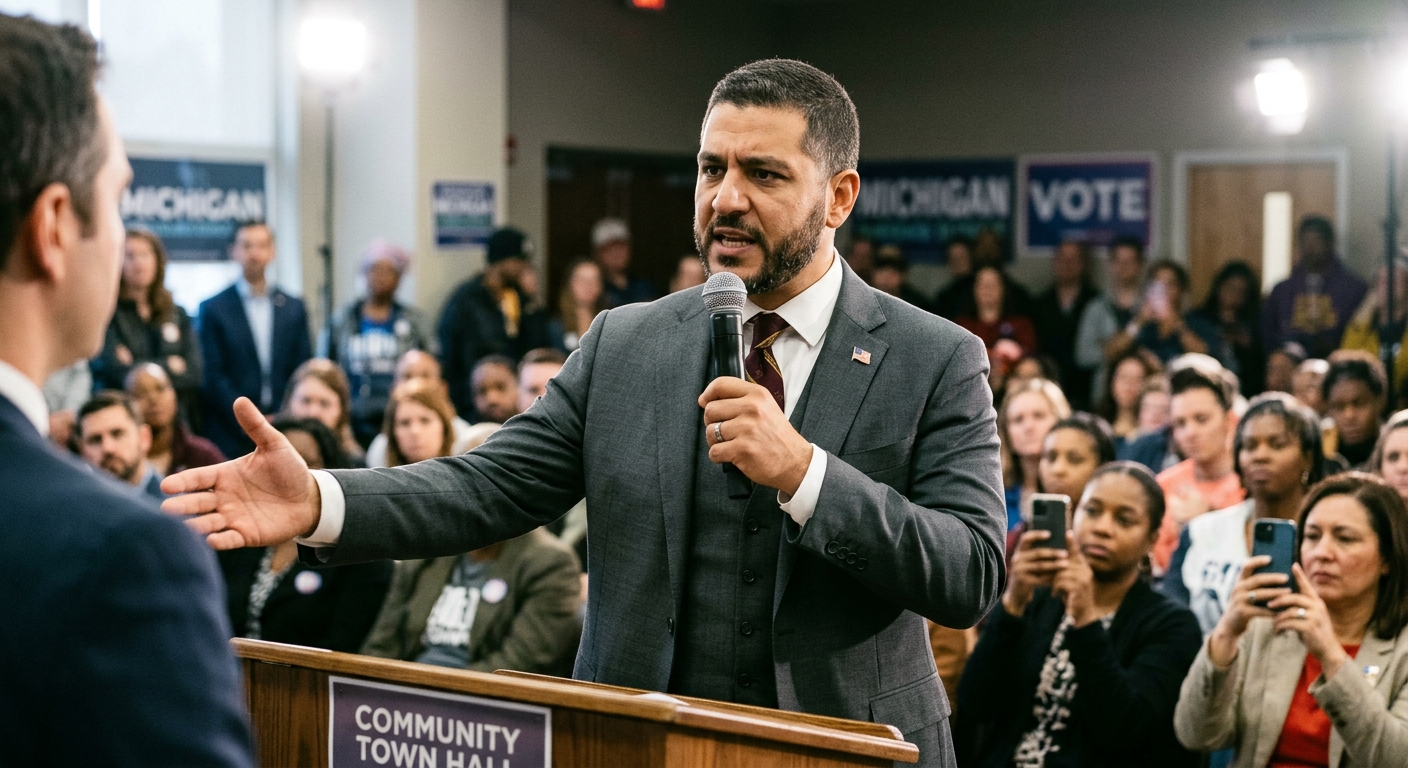
Abdul El-Sayed, a Democratic US Senate candidate in Michigan, is confronting critics head-on amidst severe Islamophobic attacks. Instead of merely defending himself, El-Sayed challenges the premise of questions regarding his faith, loyalty, and positions on Israel, turning the scrutiny back on his interrogators. This direct approach, exemplified by a viral town hall exchange, has earned him a reputation for challenging the political establishment and exposing what he sees as biased questioning.
Abdul El-Sayed, a Democratic candidate for US Senate in Michigan, is facing what researchers describe as the worst Islamophobic attacks since 9/11. However, instead of simply defending himself, El-Sayed has adopted a confrontational strategy, repeatedly demanding that those questioning his positions on Israel, the Muslim Brotherhood, and his faith explain the premise of their inquiries. He aims to put their assumptions on trial rather than let his loyalties be questioned unchallenged. A clear example is a viral town hall exchange where he was asked to disavow the Muslim Brotherhood. After agreeing, El-Sayed pressed the questioner, asking 'What are you implying? Do you assume that I wouldn’t?' He compared the question to historical doubts about JFK's Catholicism and challenged the man's understanding of the constitution. The questioner was later revealed to have ties to a Republican senator's former aide, whose father's firm had campaigned against El-Sayed. This direct style has earned him the nickname 'Mean Mamdani' or 'Meandami,' contrasting with New York City mayor Zohran Mamdani's warmer approach. El-Sayed treats confrontation as a means to expose what he perceives as a rigged political debate. His approach has left the Democratic establishment unsure how to react; despite significant outside money from pro-Israel groups backing his primary rival, El-Sayed won, daring Aipac to 'come for me' and challenging the notion that confronting powerful donors is politically prohibitive. He has consistently refused 'gotcha games' in interviews, such as when CNN repeatedly asked if Israel has a right to exist, prompting him to question why Palestine's right to exist was never asked. Similarly, on Fox, he steered conversations away from 'culture war' topics to focus on economic issues and healthcare. While effective, the tactic isn't foolproof; an attempt to dismiss questions about family ties to the Muslim Brotherhood on Meet the Press led to past family posts resurfacing. He denied personal involvement, stating he wasn't raised by his mother, but also challenged the host's 'insinuations.' This all unfolds against a hostile backdrop, with Islamophobic posts naming him surging after his primary win, and figures like Senator Tommy Tuberville and Donald Trump calling him a terrorist and jihadist. A Rutgers report notes this 'playbook' is repeatedly used against Muslim candidates. Media responses have also been scrutinized, with instances like a CBS News correspondent initially praising a questioner and describing El-Sayed's response as a 'self-own,' raising questions about how a Muslim candidate's refusal to accept an insinuation can be portrayed negatively. For Muslim and Middle Eastern candidates, the burden often extends beyond proving competence to proving their religion, family, and foreign policy views are not a threat. El-Sayed's confrontational style aims to force this distinction into the open, even if it sometimes creates challenges for him. His primary victory suggests that Democratic voters are looking for candidates willing to confront donors and party leaders they feel have ignored their values.