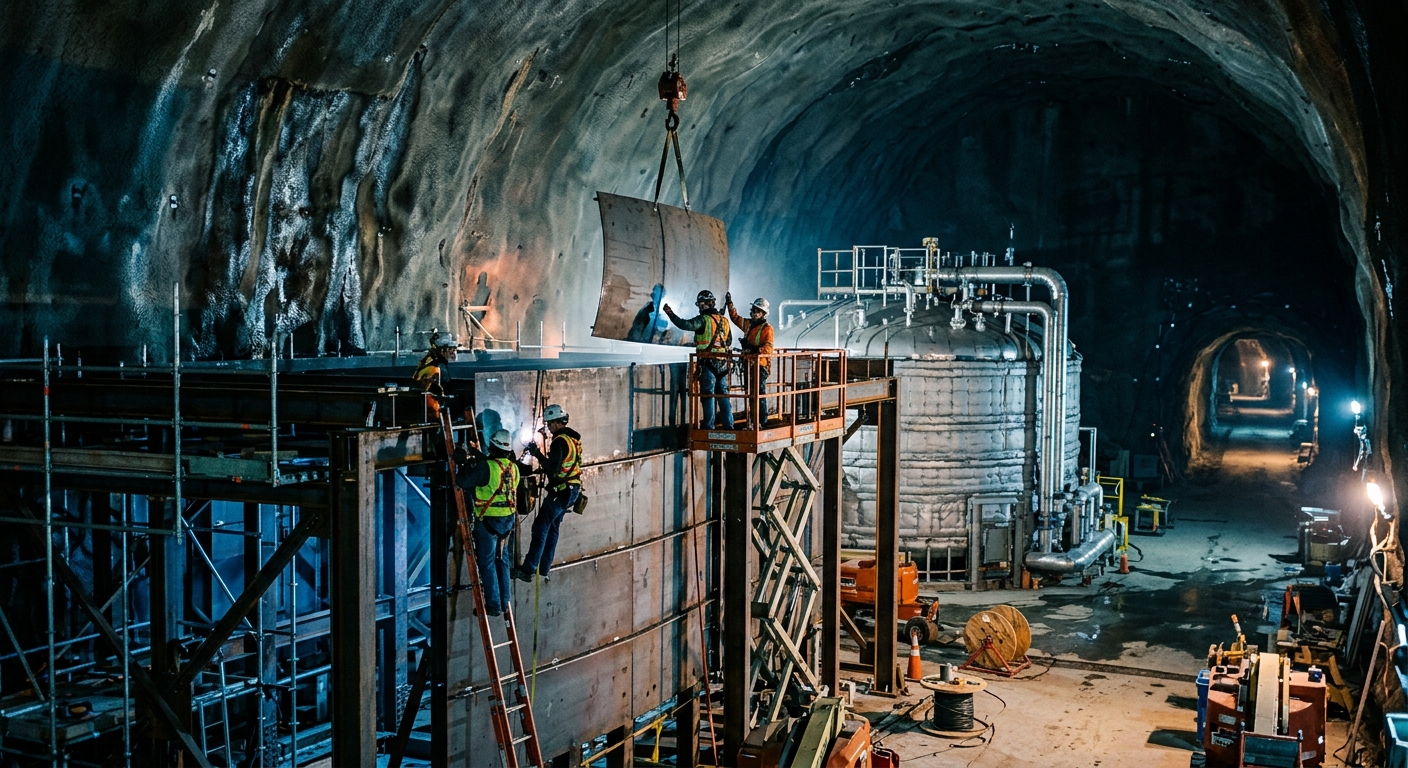
A former gold mine in Lead, South Dakota, is transforming into a cutting-edge scientific facility, hosting the Deep Underground Neutrino Experiment (Dune) to unravel the universe's deepest mysteries, from matter-antimatter asymmetry to cosmic phenomena.
The mining town of Lead, South Dakota, once a hub for gold, is now attracting scientists to its former Homestake mine, which has been converted into the Sanford Underground Research Facility (Surf). Construction is beginning on the Deep Underground Neutrino Experiment (Dune), where four giant detectors will be assembled a mile underground. These detectors will observe ghostly particles called neutrinos, arriving from sources like the sun, supernovae, and an intense beam sent 800 miles from a laboratory near Chicago. Scientists aim to solve fundamental questions, such as why the universe is made of matter and not antimatter, understand the properties of neutrinos (which are abundant, barely interact, and change types), and gain insights into cosmic events like the death of stars and the birth of black holes. The mine has a history with neutrino research, as physicist Ray Davis made pioneering detections there in the 1960s. The massive engineering project, involving over 4,000 tonnes of steel and 70,000 tonnes of liquid argon chilled to -200C, is a collaborative international effort, with the UK as a major partner. The project is expected to take years to assemble and fill, promising a 'golden era' for particle physics and bringing new opportunities to the local community.