The article dissects Sophie Cunningham's controversial rise to fame in the WNBA, arguing that she has become a symbol for conservative culture wars, leveraging anti-Black and anti-transgender sentiments, and her whiteness to gain endorsements and attention. It highlights how this shift, also involving figures like Caitlin Clark, reflects a broader political commodification within sports, creating deep fractures within the league and challenging its traditional rebellious culture.
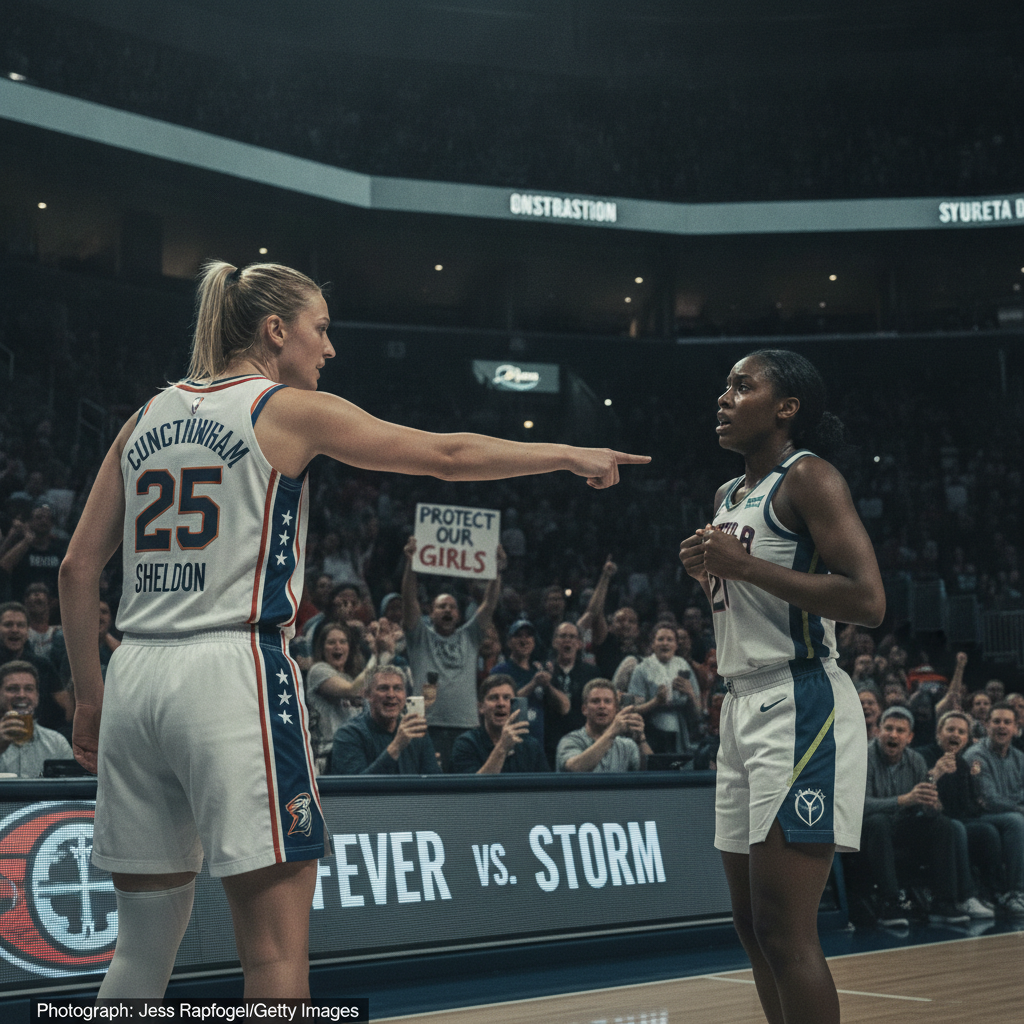
Invoking a wounded innocence that their desire for sports to be simple, just like they used to be, conservatives for a decade and a half have dreaded the word “politics”. Now they cannot get enough. Philadelphia Eagles defensive coordinator Vic Fangio has spent 40 years in the National Football League unknown except for his defensive schemes, but last week opened his press remarks mocking the congressional testimony of Dr Anthony Fauci, jokingly invoking the Fifth Amendment before taking questions. Apropos of nothing, President Trump publicly surmised that LeBron James might be a racist. Indiana Fever guard Sophie Cunningham is now in the act, accepting the role as the right’s anti-Black, anti-transgender culture war ambassador, the role originally intended for Caitlin Clark. If Clark has lacked the courage and dexterity to say anything beyond the milky and ambiguous, Sophie Cunningham does not suffer from such internal conflicts. Largely anonymous politically or otherwise during her eight-year career, Cunningham – she of the viral finger-point which has been adopted as a symbol of the white animosity toward the WNBA culture – is in her moment. Her comments in a lengthy 21 July ESPN profile stating her opposition to transgender athletes has earned her hero status of the specious “Protect Our Girls” movement, even though you’d need a microscope to find any critical mass of transgender women participating in sports at any level. Cunningham plays role of the blithe and bubbly iconoclast, oblivious to the world around as she unapologetically speaks her truths, but she is every bit as political as Colin Kaepernick, Megan Rapinoe, or her locked-armed, T-shirt wearing colleagues that defined the WNBA when she first entered the league in 2019. Cunningham forged a tough, take-no-prisoners-without-taking-herself-too-seriously persona, but was too meek to address the toxic roots of her newfound fame. Sophie Cunningham (right) and Caitlin Clark have become the WNBA’s most talked-about teammates for better or worse. Photograph: Jess Rapfogel/Getty Images So too, was ESPN, which waited nearly 75 paragraphs just to sidestep the foundation of Cunningham’s rise: she is profiting from cultural fractures that may be good for her but are tearing her league apart: double quotation markCunningham intentionally yanked Sheldon down by her neck and was hailed as a protector. A year later, the Mercury’s Alyssa Thomas put her fist to Clark’s throat – accidentally, Thomas says – and was excoriated as reckless and worse. The circumstances were different, but both were undeniable fouls that merited punishment from the league. One player – Cunningham, who is white – earned a flood of new endorsements in the aftermath. The other – Thomas, who is Black – a barrage of death threats. It’s a truth that is as inescapable as it is difficult to grapple with. Cunningham prides herself on being an open book, but through her representative, declined to discuss the role race played in the public perception of her fight and rise. So, too, did a handful of current WNBA players. Cunningham’s moment arrives with two fundamental differences. The first is that she does not represent the politics of change but the politics of reinforcement. The WNBA doesn’t have a racial problem. It is not fighting a culture war, but a civil one, navigating the seismic reality that the price of the league’s increased revenues and popularity will be the arrival of men, its bro culture, its hetero lens that consumes sports largely through its objectifying of women, its insistence in controlling whatever space it occupies. Like all entrenched powers, men don’t share. They take. Cunningham is well positioned to thrive in this new world. Just as Clark’s long-range shooting made the W accessible to the men who either ridiculed or ignored women’s sports, so too does Cunningham’s barstool friendliness. With mainstream money comes the mainstream language – and its accompanying racism and misogyny. Her whiteness sells. Her whiteness and straightness in a time of nationwide anti-blackness and homophobia sell even more. Cunningham doesn’t fight it. She bathes in it. People rally to support Sophie Cunningham after her comments on transgender athletes in women’s sports before a game between the Fever and Fire in Portland on Friday night. Photograph: Craig Mitchelldyer/AP As the WNBA rightsholder, ESPN knows this, too. Neither the league nor the network is less political – its politics have merely shifted. ESPN has yet to analyze in any meaningful way the powerful levers that are instigating these tremors – the congressional threats last month to investigate the treatment of Clark and their accusation that Clark is a victim of on-court racial harassment – but followed up burying Cunningham’s unwillingness to discuss her role as an avatar with another column blaming the league for “shooting itself in the foot” in its handling of anti-transgender protests, all without an acknowledgment of the coordinated political forces targeting the league. The great essayist Rebecca Solnit would refer to this eliding as “status quo bias”, neutral-appearing coverage because the actions of the mainstream are baked into the everyday, but whatever qualifies as normal is nevertheless political, especially in a time when today’s normal is so obviously corrosive. She knows exactly who she’s talking to and what she’s not protecting, which is the old rebellious WNBA culture. Sophie Cunningham is not a rebel. She’s a sentry. The second difference is that in an attention economy, where being noticed is the currency, Cunningham is using the attention not to further a cause, but to further herself. She has been likened as a modern-day Dennis Rodman in her ability to draw attention to herself, but Rodman was a Hall of Fame player and as a player, Cunningham is moderately impactful. She understands the source of the attention – the white dude bros who are the engine of the male sports economy who need a sexy, long-legged blonde to fuel their interest in the women’s – and the avenues it provides: the broadcast booth, the paid celebrity appearances, the playful get-over-yourselves UFC ring girl brand. She’s setting up her second act, and if she plays these 15 minutes right, they could last 30 years. It’s an obvious, empty grift for an obvious, empty culture. Free newsletter | Weekly for the 2026 WNBA season Sign up to WNBA 30 A limited run women’s basketball newsletter dedicated to the league’s historic 30th season. Preview latest Enter your email Sign up Sophie Cunningham made an appearance as a UFC ring girl last month in Las Vegas. Photograph: Chris Unger/Zuffa LLC It’s also an old playbook. Just as the Black body has always outvalued the Black brain as its main asset in America whether it be the cotton field or the playing field, so too it is with women – sex is always near. The former tennis star Anna Kournikova never won a WTA tournament – not a single one – yet everyone knew her name. Blonde and perky will do that. When the LPGA was launching, how did women’s golf get its boost? By putting the blonde-haired, blue-eyed Aussie Jan Stephenson on the May 1977 cover of Sport Magazine, smiling and braless, showing just enough cleavage, just enough nipple to tantalize the boys. Golf Magazine put Stephenson on its cover, recreating the iconic Marilyn Monroe subway grate scene from The Seven-Year Itch. Stephenson did a calendar shoot posing in a bathtub full of golf balls. If the Title IX revolution sought equality and respect, Cunningham has reminded it that nothing builds bank accounts faster than long legs and pandering to the boys. Sophie Cunningham has been in the league eight years. She’ll be 30 later this month, five and a half years older than Clark, and for the large majority of those years, she’s been a serviceable, unremarkable player who is a top-notch three-point shooter. She wasn’t even who the marketers picked to sell sex to the boys – the role of the glammed-up, blonde beauty baller belonged to 6ft 4in Cameron Brink. Cunningham needed the culture war to get on the map, needing it as much as it needed her, and all it took was a silly finger-point and being in opposition to someone Black. To the aggrieved whites, standing up to someone Black meant standing up for them. Add transphobia to her portfolio, and the result is a star, the latest participant in an old game no more complicated than checkers but far less interesting. Howard Bryant is the author of 11 books, including The Heritage: Black Athletes, A Divided America, and the Politics of Patriotism and Kings and Pawns: Jackie Robinson and Paul Robeson in America.