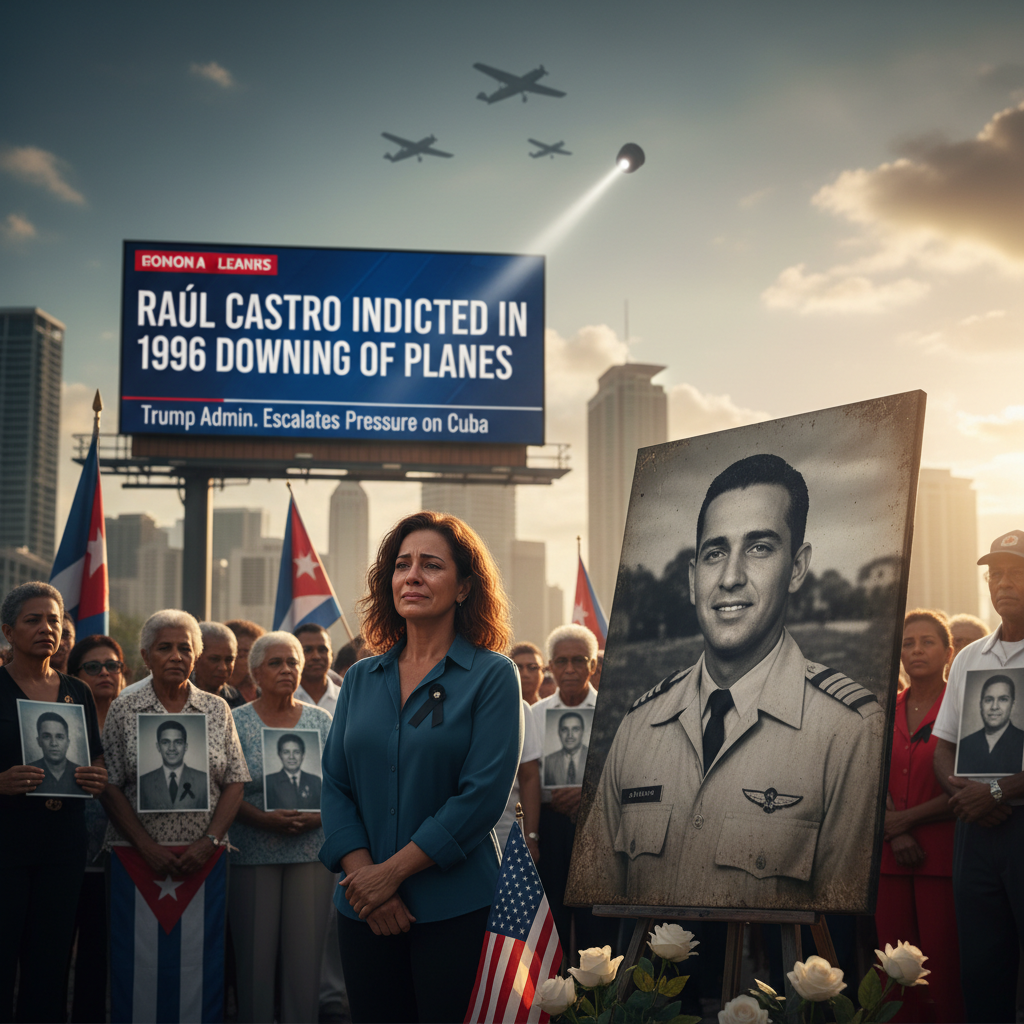
Federal prosecutors have announced criminal charges, including murder and conspiracy, against former Cuban President Raúl Castro for the 1996 downing of two civilian planes flown by Miami-based exiles. This move escalates pressure from the Trump administration on Cuba, with a warrant issued for Castro's arrest and potential life imprisonment or the death penalty upon conviction. Cuban President Miguel Díaz-Canel condemned the indictment as a political stunt, while victims' families welcome the long-awaited pursuit of justice.
MIAMI (AP) — Federal prosecutors on Wednesday announced criminal charges against former Cuban President Raúl Castro in the 1996 downing of civilian planes flown by Miami-based exiles as the Trump administration escalated pressure on the island’s socialist government. Asked to what lengths American authorities would go to bring Castro to face charges in the U.S., Blanche said: “There was a warrant issued for his arrest. So we expect that he will show up here, by his own will or by another way.” Asked what will happen next for Cuba, President Donald Trump said, “We’re going to see.” He added that the U.S. is ready to provide humanitarian assistance to a “failing nation.” The charges pose a real threat, observers said, following the capture by U.S. forces in January of former Venezuelan President Nicolás Maduro to face drug charges in New York. “He’s going to have to keep his head pretty low from now on,” said Peter Kornbluh, a specialist on the U.S.-Cuba relationship at the National Security Archive at George Washington University. Cuban president condemns indictment While it remains unclear whether Castro will ever step foot in a U.S. courtroom, the murder and conspiracy charges carry the potential for life in prison or the death penalty upon conviction. Cuban President Miguel Díaz-Canel condemned the indictment as a political stunt that sought only to “justify the folly of a military aggression against Cuba.” In a message on social media, he accused the U.S. of lying and manipulating events surrounding the shootdown, including ignoring repeated warnings by Cuban officials at the time that they would defend against “dangerous violations” of their airspace “by notorious terrorists.” Among those attending Wednesday’s ceremony in downtown Miami was Marlene Alejandre-Triana, whose father, Armando Alejandre Jr, was killed while she was away for her first year of college. Over the years, she spoke to multiple federal investigators about charging Castro, referring to him as “one of the main architects of the crime.” But none until now had the courage to seek justice for her family and the other victims. “It has been long overdue,” she said standing before a giant photo of her father. Trump has threatened military action for months Trump has been threatening military action in Cuba ever since U.S. forces captured Maduro, the Cuban government’s longtime patron. After ousting the Venezuelan leader, the White House ordered a blockade that choked off fuel shipments to Cuba, leading to severe blackouts, food shortages and an economic collapse across the island. A Brothers to the Rescue plane flies over The Democracy Movement flotilla at the twelve-mile limit north of Havana, Cuba, July 10, 1999. (AP Photo/Alan Diaz, File) Since Maduro’s capture, Trump has ratcheted up talk of regime change in Cuba after pledging earlier this year to conduct a “friendly takeover” of the country if its leadership did not open its economy to American investment and kick out U.S. adversaries. Trump’s first administration indicted Maduro on drug-trafficking charges and used that to justify removing him from power and whisking him to New York to face trial. Secretary of State Marco Rubio on Wednesday urged the Cuban people to demand a free-market economy with new leadership that he said will chart a new course in relations with the U.S. “In the U.S., we are ready to open a new chapter in the relationship between our people,” Rubio, the son of Cuban immigrants, said in a Spanish-language video message. “Currently, the only thing standing in the way of a better future are those who control your country.” Raúl Castro believed to wield power behind the scenes Cuba’s President Raul Castro listens to the Cuban and Venezuelan national anthems during his welcome ceremony at the Miraflores presidential palace, March 17, 2015, in Caracas, Venezuela. (AP Photo/Ariana Cubillos, File) Castro took over as president from his ailing older brother Fidel Castro in 2006 before handing power to a trusted loyalist, Díaz-Canel, in 2018. While he retired in 2021 as head of the Cuban Communist Party, he is widely believed to wield power behind the scenes, underscored by the prominence of his grandson, Raúl Guillermo Rodríguez Castro, who previously met secretly with Rubio. Last week, CIA Director John Ratcliffe traveled to Havana for meetings with Cuban officials, including Castro’s grandson. Two other senior State Department officials met with the grandson in April. The investigation into Castro stretches back to the 1990s In 1995, planes flown by members of Brothers to the Rescue buzzed over Havana dropping leaflets urging Cubans to rise up against the Castro government. After Cuban protests, the Federal Aviation Administration also opened an investigation and met with the group’s leaders to urge them to ground the flights, according to declassified government records obtained by the National Security Archive. But those calls went unheeded and on Feb. 24, 1996, missiles fired by Russian-made MiG-29 fighter jets downed two unarmed civilian Cessna planes a short distance north of Havana just beyond Cuba’s airspace. All four men aboard were killed. A third plane, carrying the group’s leader, narrowly escaped. Raúl Castro faced earlier indictment Mario de la Pena carries a poster with the photos of the four pilots shot down by the Cuban air force MiG-29 fighter jets, his son Mario de la Pena, top right, was among the pilots, during a freedom for Cuba march in Miami, Feb. 24, 2011. (AP Photo/Alan Diaz, File) Guy Lewis, who was a federal prosecutor in Miami in the 1990s, first uncovered evidence linking senior Cuban military officials to cocaine trafficking by Colombia’s Medellin cartel. Following the shootdown, the investigation expanded, and prosecutors pursued charges against Raúl Castro for leading a vast racketeering conspiracy by Cuba’s armed forces. In the end, only the head of the Cuban air force and two of the MiG pilots involved in the downing of the planes were indicted but have never been apprehended. A fourth individual was convicted of leading a Miami-based spy ring called Operation Scorpion that collected intelligence about the flights. He was later swapped for a U.S. intelligence asset imprisoned in Cuba as part of President Barack Obama’s outreach to Cuba. The shootdown led the U.S. to harden its position against Cuba, even though the Cold War had ended and the Castros’ support for revolution across Latin America was a fading memory. But Castro himself was spared as the Clinton administration raised concerns about such a high-profile indictment. ___ Durkin Richer reported from Washington. Associated Press reporters David Fischer in Miami; Dánica Coto in San Juan, Puerto Rico; Meg Kinnard in Houston; Will Weissert in Washington; Michael Weissenstein in New York; and John Seewer in Toledo, Ohio, contributed to this report.