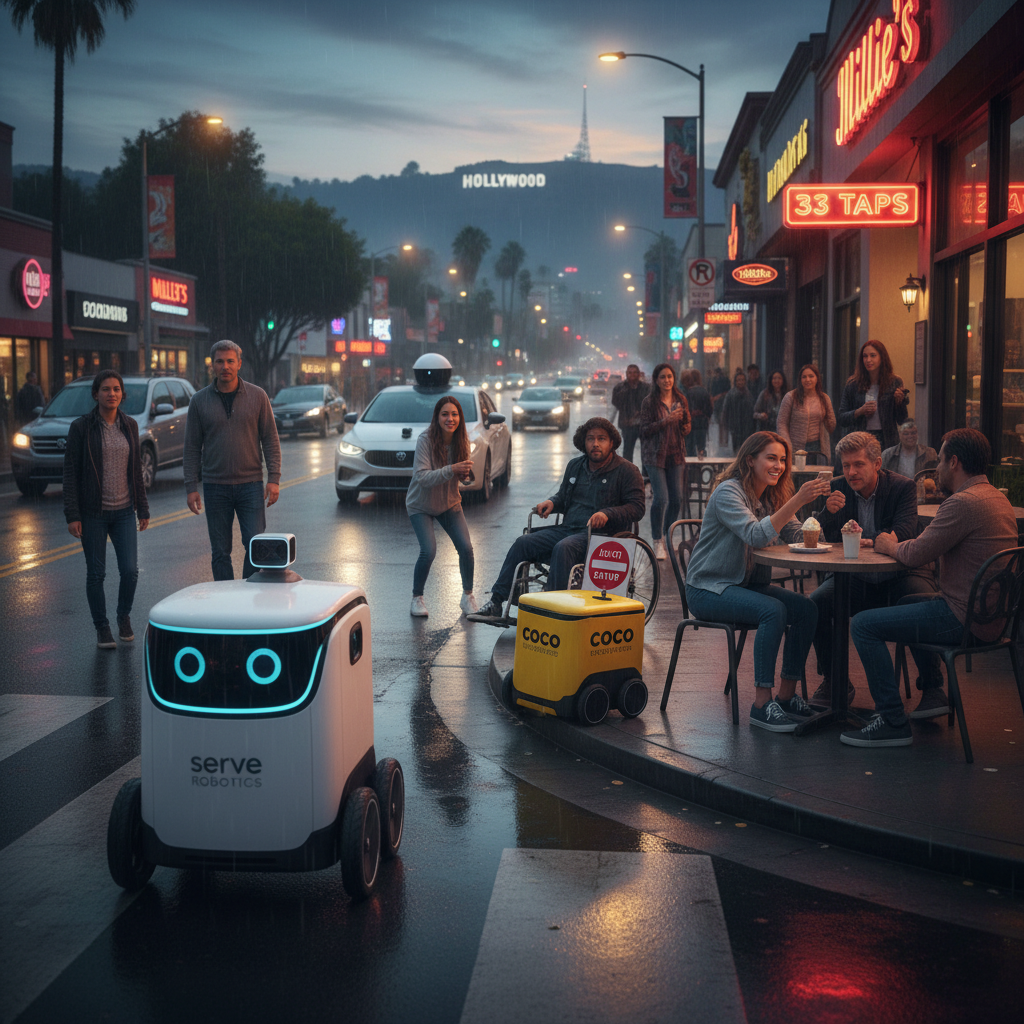
Los Angeles is experiencing a rapid increase in autonomous robots, from Waymo driverless cars to food delivery bots like Serve and Coco. This expansion has sparked a debate among residents, businesses, and city planners regarding their impact on pedestrian traffic, job displacement, urban design, and overall quality of life, despite their potential environmental and convenience benefits.
Los Angeles is witnessing a significant surge in autonomous robots, ranging from Waymo's driverless vehicles to fleets of food delivery bots from companies like Serve Robotics and Coco Robotics. Serve recently deployed 500 new bots across 40 neighborhoods, while Coco has around 300. This proliferation has generated considerable discussion and mixed reactions among LA residents and businesses. While some cities like Glendale are considering moratoriums due to concerns about sidewalk congestion, safety, and potential job displacement for human delivery drivers, the robots also offer benefits. They are environmentally friendly, producing no exhaust fumes, and can be undeniably cute, often eliciting empathy from bystanders, especially when facing challenges like rainstorms or needing help with crosswalk buttons. However, many Angelenos express frustration. Businesses along busy thoroughfares like Sunset Blvd, particularly those with outdoor seating, report that robots block foot traffic, annoy customers, and even hit people. Staff at places like Pazzo Gelato and Millie's Cafe describe them as a "nuisance" or express outright "hate." Concerns about job losses for drivers and accessibility issues for people with disabilities, particularly wheelchair users, are also prevalent. Incidents, though rare, have included a robot hitting a cyclist in New Jersey (denied by the company) and another shattering a bus shelter in Chicago, along with a minor collision between a Waymo and a delivery robot in LA. Experts like Steven Gehrke from Northern Arizona University highlight "growth pains" in deploying these devices, noting their tendency to stop and obstruct paths when encountering humans. He suggests strategies like barring them from narrow streets. Researchers at Cornell University are developing a "robotability score" to guide urban planners, emphasizing respect for existing pedestrian patterns and community-centric deployment. Despite the inconveniences and safety concerns, some view the robot influx as an inevitable technological shift. Joe McDonough at 33 Taps sees "bugs" as part of any new tech's rollout, while executive chef David Potes acknowledges frustrations but sees it as part of modern life. Yet, resistance persists, with some individuals like "Petra" actively disabling bots, arguing they worsen LA's already poor pedestrian environment and lack clear social benefits. The debate continues as LA grapples with integrating these new robotic "neighbors" into its urban fabric.